Learn chess
What age to start chess? A guide by age
What a child of 4 to 5, 6 to 7, 8 to 10 and a teenager can understand, signs that they are ready and what to do if they are very young. No magic ages.
"At what age can my child start chess?" It is one of the questions parents ask most often, and the honest answer is less round than one would like: there is no magic age. Some 4-year-olds have fun moving the knight and some 8-year-olds have no interest yet. And there are teenagers and adults who start from zero and enjoy it just the same.
A clarification before going on. In this article we do not cite studies about the ideal age, because we have not found a reliable source that sets one. What follows is practical judgment: reasonable guidelines for deciding what to try at each age, which each child may meet sooner or later. If anyone assures you of an exact age, be wary.
Key points
- There is no magic age: the child's interest and patience matter more than their birth date.
- At 4 or 5 years chess is above all play: one piece at a time, a short time and no hurry for full games.
- Between 6 and 7, many children can already learn all the rules and play their first games.
- Between 8 and 10 you can work on ideas of tactics and strategy, and some children want to compete.
- A teenager can start from zero with no problem: starting late is not being late.
- If a child is very young, do not force it: wait, or play with the pieces as toys.
Is my child ready? Five signs
There is no exam, but these signs help you decide if it is a good moment:
- They ask to play, or they stay looking at the board when someone plays.
- They can wait their turn in a board game, even if only for a short while.
- They follow two-step instructions ("take the knight and bring it here").
- They tolerate losing a little without the game ending in shouting. (If not, it can be worked on; see my child gets upset when losing.)
- They last 10 minutes with a game without getting up. With less time it can also be done, just in shorter sessions.
You do not need to meet all five. They are hints, not requirements.
From 4 to 5 years: chess as play
At this age, it is normal for the child not to retain all the rules, and that is fine. What you are looking for is that they get to know the pieces, enjoy the board and associate chess with a pleasant time.
What you can do:
- Name the pieces and tie them to a story (the knight that jumps, the rook that goes in a straight line).
- One-piece games: the rook that eats pawns, the knight that jumps over a full board. There are several in how to teach chess at home.
- Very short sessions, about 10 minutes at most.
- No full games for now. Giving a real checkmate can wait.
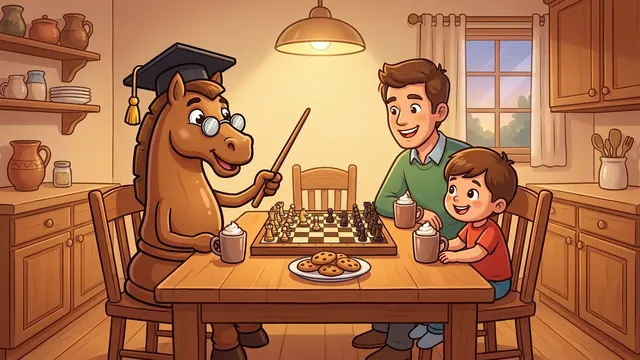
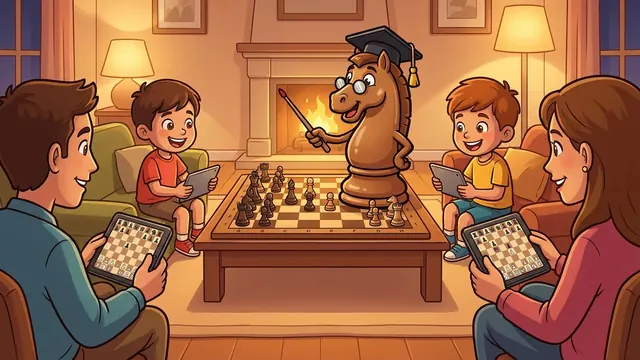
What to avoid: correcting non-stop, asking them to play "well", and comparing with other children. The Chess Academy Kids app is designed for children from age 4, with a voiced knight professor who guides the course in lessons, and it has exercises with hints; the first module of the course is free.
From 6 to 7 years: first full rules and first games
At 6 or 7, many children can already learn all the basic rules (how each piece moves, what check and checkmate are) and play simple games, though often with mistakes. Some take longer, and that is normal.
What you can do:
- Review how the pieces move and the chess rules for kids.
- Practise mate in one and the idea of protecting a piece.
- Play short, frequent games, with the option of taking moves back.
- Introduce one new idea at a time: the center, bringing out the knights, castling.
In this range the first tantrums over losing may appear. It is common and it has a fix, with calm and a lot of example.
From 8 to 10 years: tactics, plans and the wish to compete
At this age, many children already master the rules and can start thinking about the opponent's moves. It is a good time to work on:
- Basic tactics: fork, pin, double attack (there are articles on the fork and the pin).
- Opening principles: center, development and king safety (simple openings).
- Simple endings, like queen and rook checkmates.
- Reviewing a game together and finding the mistake.
If the child wants, clubs and small tournaments may appear. Go carefully: competition hooks some and overwhelms others, so it is better to try it gradually and let them decide.
Teenagers: starting from zero also works
If your teenage son or daughter wants to start, they are not late. They can usually grasp ideas in a more abstract way, plan several moves ahead and learn with books, videos or games on their own. At this age what weighs most is their own motivation: that they choose it.
What helps:
- Leave the pace to them: they may move fast through the rules and then spend a long time on tactics.
- Offer resources and let them explore, without watching every step.
- Accept that they may play more with friends or on a screen than at home.
If they are very young: what to do
A 3-year-old (or a 4-year-old who is not interested yet) does not need to start right now. Some ideas for waiting without giving up:
- Leave a board and pieces in sight, like a toy. Let them touch them, arrange them, sort them by color.
- Play simple board games that teach turns, counting and waiting: it is a good base for any game with rules.
- Let them watch you play with someone else, without pressure.
- Try again a few months later: what meant nothing yesterday may be their favorite game today.
And if they have already started and get blocked, it is better to pause than to insist. My child loses interest in chess covers it. It is not a failure: it is a rest.
A ten-minute test
If you are not sure whether it is a good moment, there is a very simple test: sit down with the board and show them just one piece, for example the knight and its L-shaped jump, for about ten minutes and as a game. If at the end they ask to do it again, or walk off to another room with the knight in their hand, that is a good sign. If they get up after two minutes, it does not matter: put the board away and try again in a few weeks. Neither result says anything about how good they will be at chess in the future; it only tells you whether they feel like it today.
And you, how do you do it?
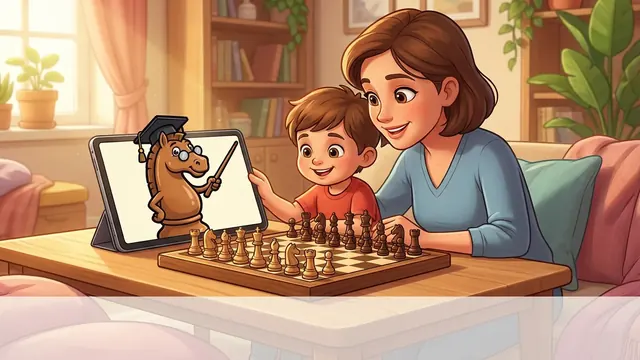
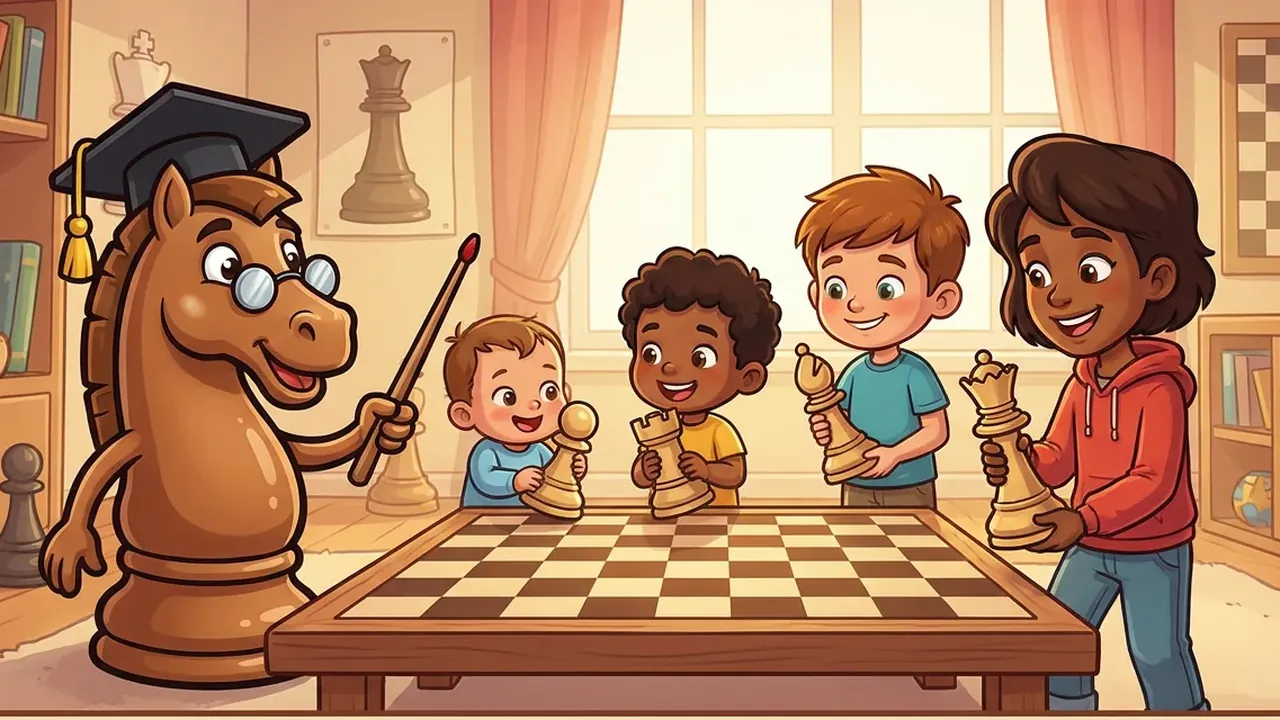
Every child is different. If there are siblings of different ages at home, each child can have a profile in the app and move at their own pace. And for parents who do not know how to play, there is the article I do not know chess and I want to teach my child.
What is the minimum age to start playing chess?
There is no fixed minimum age. Many children enjoy chess from 4 or 5 years old if it is presented as play, one piece at a time and with very short sessions. It depends more on each child's interest and patience than on their age.
Is it too late to start at 12 or 14?
No. A teenager can start from zero and learn well, often with more autonomy. What counts most is that they want to do it; they set the pace.
What do I do if my 4-year-old has no interest?
Nothing urgent. You can leave the board in sight, play simple board games and try again a few months later. Forcing it is usually worse than waiting.