Learn chess
The fork in chess: attack two pieces with a single move
What a fork is in chess, how the knight, pawn, queen and bishop make it, how to spot it and how to defend against it. With diagrams and exercises for kids.
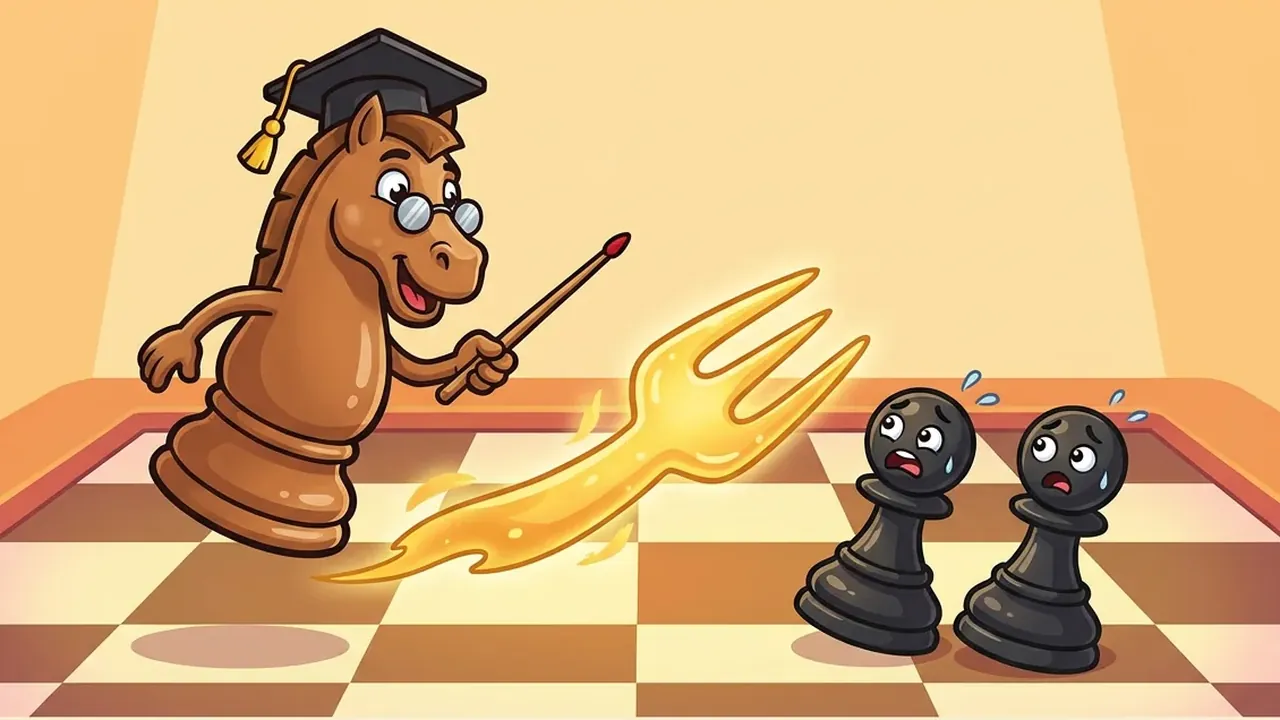
A fork is a move in which one single piece attacks two enemy pieces at the same time. The opponent can only save one, and you win the other. It is the most famous tactic and the one that wins the most pieces among kids.
Key points
- A fork is one piece attacking two things at once.
- It is best when the two attacked pieces are worth more than the attacker, or when one of them is the king.
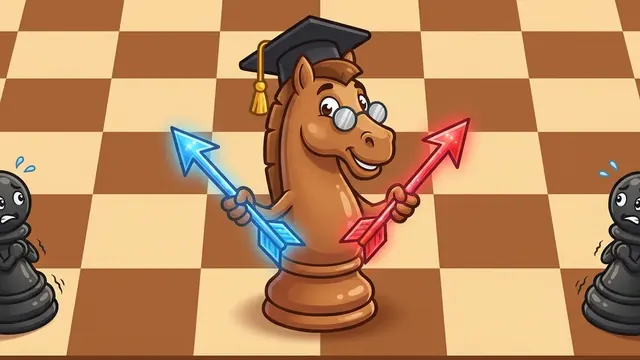
- The knight is the king of forks, because it jumps and attacks in an L shape.
- Pawns also make forks, and they are the cheapest ones.
- To avoid a fork, check which squares the enemy knight can jump to.
What a fork is, in one sentence
A piece goes to a square where it attacks two enemy pieces at once, and the opponent cannot save both.
It is like a table fork: it has two prongs, and with one move it spears two things.
If your child already knows how the pieces move (how chess pieces move), this is the first tactic that will make them feel they can "see things" on the board.
Example 1: the knight fork, with check
This is the favorite. The knight goes to a square from which it checks the king and, at the same time, attacks the queen.
The knight jumps from d5 to e7. From e7 it attacks g8 (the king, check) and c8 (the queen). The king has to move and, on the next move, the knight captures the queen. No black piece can capture the knight on e7.
The fork with check is the best because the opponent cannot choose: they have to deal with the check, and the other piece falls.
Example 2: the pawn fork
A pawn that advances attacks the two diagonal squares in front of it. If there are two enemy pieces there, it attacks both.
The pawn on e4 advances to e5 and attacks the knights on d6 and f6. One of them falls. On top of that, those two knights cannot protect each other, because each one attacks squares of the color opposite to its own.
It is the cheapest fork: you win a piece worth 3 points for nothing, with a pawn. Kids love it when they discover it.
Example 3: the queen fork
The queen can also make forks, especially with check.
The queen goes up to h5, checks the king along one diagonal and, along the other diagonal, attacks the rook on d1. The king cannot protect the rook. After the king moves, the queen captures the rook.
One important detail: before making a fork, check that the attacked pieces cannot capture the one that attacks. Here the rook on d1 cannot capture the queen on h5, and that is why it works.
Example 4: how to avoid a fork
Look at this position with Black. The white knight on d5 threatens to jump to c7 with check and attack the rook.
Black plays the king to d8. Now c7 is watched by the king, and if the knight jumps there, the king captures it. The best defense against a fork is to watch the square it would be made from.
The typical mistake
- Not looking at the enemy knight's jumps. It is the number one cause of lost pieces: the child looks at where the "big" pieces go and forgets the knight.
- Leaving two loose pieces (unprotected) that a single knight can attack from the same square. The mere existence of that square is enough for the opponent to find it.
- Making a fork without checking whether the opponent can capture the piece that makes it. Sometimes the attacking piece is left unprotected and is lost.
- Looking only at your own fork. Also look at what happens if the opponent has an in-between check.
How to spot it in a game: the magic question
There are two questions, one for attacking and one for defending:
- To attack: is there a square from which one of my pieces attacks two things at once, and the opponent cannot capture it?
- To defend: is there a square from which an enemy piece can attack two of my pieces at once?
Go through them before every move and many oversights will disappear. If your child tends to move very fast, these questions are a good brake: see my child plays too fast without thinking.
How to defend
- Watch the jump squares. If you see a square from which the enemy knight could attack two of your pieces, protect it or occupy it.
- Keep your pieces apart. Avoid having your queen and rook a knight's jump apart.
- Counterattack. If you cannot avoid the fork, sometimes you can give a check or a bigger threat first.
- Trade the piece that would make the fork if you can, before it jumps.
A trick to remember it
"Two prongs, one fork." Before moving, imagine a fork on the board and ask where it would spear.
Another trick: knights love a mess. If two pieces of yours or of the opponent's are loose, unprotected, a knight can come in. Tidying up your pieces is the best medicine.
Exercises to do at home
Exercise 1: knight against queen and king
White to move. Which knight jump attacks the queen and the king at once, with check?
Solution: the knight jumps to f7. It checks the king on h8 and attacks the queen on d8. The king moves and the knight captures the queen.
Exercise 2: pawn fork
Black has two knights and White has a pawn. Which pawn advances to attack both knights?
Solution: the pawn from d4 advances to d5, attacks both knights on c6 and e6, and one of them falls.
Exercise 3: bishop with check
White's bishop on f1 can give check and attack a rook at the same time. Which square does it go to?
Solution: the bishop goes to b5. From there it checks the king on e8 and attacks the rook on a6. The king moves and the bishop captures the rook.
Where to practice it
The app has tactics puzzles with a hint and a solution, and the fork is one of the first: chess puzzles for kids: tactics. The course with the knight professor has a tactics lesson that explains it step by step: chess course with the knight professor. And to put it into practice in real games, you can play against the app with a coach.
If you want to carry on with tactics, the natural next reads are the pin in chess, double attack in chess and discovered attack and discovered check.
Which piece makes the best forks?
The knight, because it jumps over other pieces and attacks squares no other piece watches. But any piece can make a fork, including pawns, the queen, the bishop and the rook.
What is the difference between a fork and a double attack?
A fork is one type of double attack in which one piece attacks two enemy pieces. A double attack is more general: it can be a threat of mate plus the capture of a piece, for example. We explain it in the double attack article.
At what age can a child learn the fork?
When they know how all the pieces move and the rules of check, usually from 6 or 7 years old. It is learned better with short puzzles than with theory.