Learn chess
The pin in chess: when a piece cannot move
What a pin is in chess, the difference between an absolute and a relative pin, how to use it and how to defend against it. With diagrams and exercises for kids.
A pin is when a piece cannot (or should not) move because, if it does, it leaves a more valuable piece of its own side in danger. The attacking piece "pins" the piece in front of it to the one behind, like a pin holding a butterfly on a board.
Key points
- Only long-range pieces pin: bishop, rook and queen.
- In a pin there are three pieces on one line: the one that pins, the pinned one and the one behind.
- If the king is behind, the pin is absolute: the pinned piece cannot move (it is illegal).
- If another piece is behind (for example the queen), the pin is relative: the piece can move, but it would lose what is behind.
- A pinned piece is an easy target: attack it again.
What a pin is, in one sentence
It is a threat along a straight line: a long-range piece attacks an enemy piece that has a more important piece behind it, and the piece in front cannot move without losing the one behind.
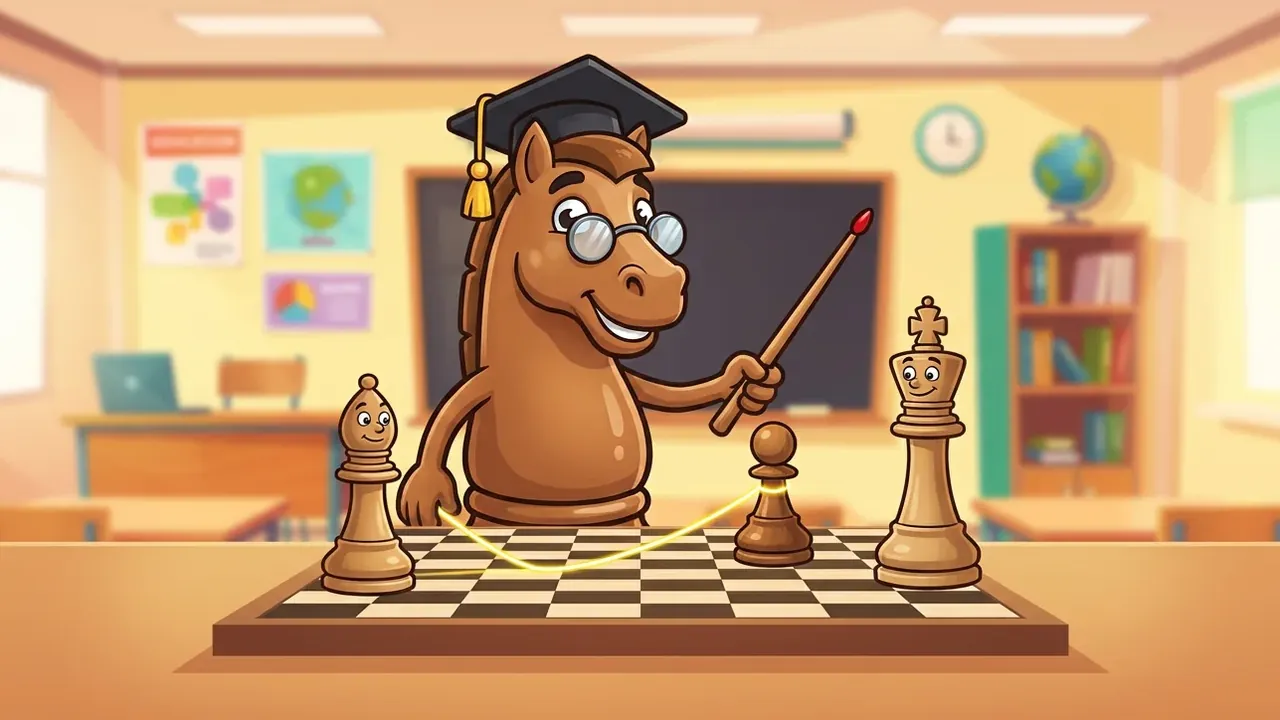
For a child: it is like the game "the floor is lava" with a rope. The pinned piece is stuck to its friend behind, and if it steps away, the other one is left exposed.
Absolute pin: the king behind
Here the pinned piece cannot move: it is illegal. A king can never be left in check, so if the piece moved, it would leave the king in check.
See what happens: the knight is attacked twice (by the bishop on b5 and by the rook on d1) and defended only once (by the king). White plays the rook to d7 and captures the knight. The king cannot recapture, because the bishop on b5 also watches that square.
This is the best moment to attack a pinned piece: it cannot escape and the opponent has to defend it. If you add attackers, you win it.
A case with a pawn
Absolute pins are exploited very well with a pawn: it costs nothing and it cannot run away.
The knight on c6 is pinned by the bishop on b5 against the king on e8. White pushes the pawn to d5, which attacks the knight. The knight cannot move, and the king can only try to step aside; when it does, the pawn captures the knight.
Relative pin: a valuable piece behind
If behind the pinned piece there is not the king but another valuable piece, the pin is relative. The piece can move, but it would lose what is behind it.
If Black moves the knight (to e4, say), the bishop captures the queen on d8. Moving the knight would be a blunder, though not an illegal move.
A relative pin is very useful because it freezes a piece without giving check. The pinned piece stays blocked, and the opponent also has to keep worrying about it.
How to defend against a pin
When the opponent is the one pinning, do not panic. What matters is whether the pinned piece is attacked and how well you defend it. You have four ways to respond:
- Block with another piece between the pinning piece and your piece (if there is room).
- Attack the pinning piece, or ask it with a pawn whether it is staying.
- Move the valuable piece behind (the king or the queen) so the pinned piece is freed.
- Protect the pinned piece well, so that even if it is attacked, it cannot be won.
In this position, the knight on f3 is pinned to the queen on d1, but it is defended by the pawn on g2. White plays h3 to attack the bishop. If the bishop captures the knight, the pawn recaptures. If it captures the pawn on h3, the pawn on g2 captures it.
The typical mistake
- Not seeing the pin the opponent makes. You move the pinned piece without noticing and lose what is behind it.
- Moving a piece that is in line with your own king or queen without checking whether the opponent has a bishop or rook aiming along that line.
- Not exploiting your own pin. If you have pinned a piece, attack that piece again: it is the best way to win it.
- Believing that a relative pin is the same as an absolute one. If it is relative, the piece can move if it pays off.
How to spot it in a game: the magic question
The question is: what is behind that piece, on the same line?
Ask it in two directions. First, looking at your pieces: before moving a piece, ask whether there is something valuable behind it and whether the opponent has a long-range piece aiming along that line. Second, looking at the opponent's: is there an enemy piece with the king or the queen right behind it on a line I can attack?
If your child tends to move fast, this question forces them to look along all the lines: my child plays too fast without thinking.
A trick to remember it
"Look behind." Two words. Before moving any piece, look at what is behind it on the bishop, rook and queen lines.
The name helps too: a pin is called that because the opponent is "pinned" in place, like with a nail. If the child pictures it, they will not forget it.
Exercises to do at home
Exercise 1: win the pinned knight
The black knight on e6 is pinned by the rook on e1 against the king on e8. Which white pawn attacks the knight?
Solution: f5. The pawn from f4 advances and attacks the knight, which cannot run away because it is pinned. White wins the knight, at most in exchange for that pawn.
Exercise 2: get out of the pin
The black bishop on a5 pins the knight on d2 against the king on e1. How does White get out of the pin without losing anything?
Solution: move the king off the bishop's line, to d1 for example. Now the knight is no longer pinned and, if the bishop captures it, the king recaptures.
Exercise 3: find the pin
White to move wants to pin the knight on f6 against the queen on d8. With which piece and to which square?
Solution: the bishop from c1 goes to g5. It pins the knight on f6 against the queen on d8: if the knight moves, the bishop captures the queen.
Where to practice it
The app has tactics puzzles with a hint and a solution, where the pin shows up again and again: chess puzzles for kids: tactics. It is also in the course with the knight professor, in the tactics block: chess course with the knight professor. To see how a pin plays out in a real game, you can play against the app with a coach.
To carry on with tactics, see the fork in chess, double attack in chess and discovered attack and discovered check.
What is the difference between an absolute and a relative pin?
In the absolute pin there is a king behind, and the pinned piece cannot move because it would be an illegal move. In the relative pin there is another valuable piece behind (like the queen): the pinned piece can move, but what is behind it is lost.
Which pieces can pin?
The bishop, the rook and the queen, because they attack along straight lines or diagonals from far away. The knight, the pawn and the king do not pin.
Can a pinned piece always be captured?
Not always: if it is well defended, attacking it is pointless. A pin only wins material when the pinned piece is attacked more times than it is defended.