Learn chess
Double attack in chess: two threats with a single move
What a double attack is in chess, how it differs from a fork, its types (mate plus capture, check plus capture), how to see it and how to avoid it. For kids.
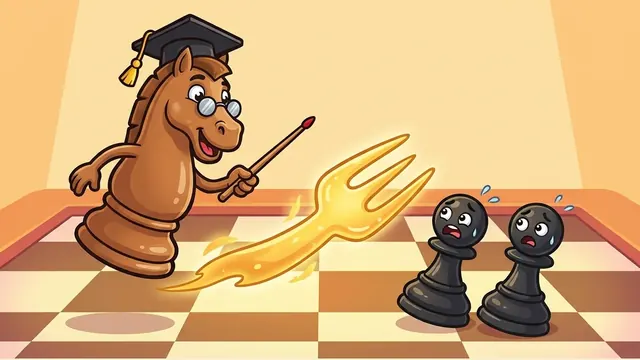
A double attack is a move that creates two threats at once, and the opponent can only stop one. The fork is the best-known form, but it is not the only one: you can also threaten a mate and a capture at the same time, or give check and attack a piece.
Key points
- A double attack is two threats with one single move.
- Every fork is a double attack, but not every double attack is a fork.
- The two threats can be of different kinds: mate and capture, check and capture, capture and promotion.
- It is best when one of the threats is a check or a mate, because the opponent cannot ignore it.
- You defend by finding one move that stops both threats, or by giving a check first.
What a double attack is, in one sentence
It is a move in which your piece (or two pieces) create two different dangers for the opponent, and there is no way to cover both in a single move.
For a child: it is like a goalkeeper facing two balls shot at the same time, to the two corners. He can only stop one.
How it differs from the fork
In the fork (see the fork in chess) one single piece attacks two enemy pieces. It is always "one piece, two targets".
In a double attack in general, the two threats can be of any kind. One can be a mate, the other a capture. Or a check and a capture. Or one piece that attacks and another that threatens. What matters is that there are two threats and the opponent cannot deal with both.
That is why we say: all forks are double attacks, but not all double attacks are forks.
Example 1: mate threat plus capture
This is the position. White has the queen and the bishop on c4 aiming at f7; Black has the king boxed in by its own pawns and a rook, and a loose bishop on a5.
The queen goes to d5. From there it launches two threats:
- Queen captures on f7, checkmate. The bishop on c4 supports it, so the king cannot capture it, and the king has no free squares.
- Queen captures the bishop on a5, which is unprotected.
Black cannot stop the mate with a move that also saves the bishop. In this particular position no defense works, and Black loses by mate or by material. Even so, notice the reasoning: two threats, one single move.
Example 2: check plus capture
This case looks like a fork, but it does not have to be between two pieces: the check is one threat, and the capture is another.
The black queen goes up to h4: it checks the white king along the diagonal and, along another diagonal, attacks the rook on d8. White has to deal with the check, and the rook cannot be saved. This double attack is also a fork (the queen attacks the king and the rook), but the trick is the same: two threats, one single move, and one of them is a check.
More types of double attack
There are others your child should recognize early:
- Mate threat and capture threat (example 1).
- Check and capture (example 2).
- Capture and promotion. A pawn that threatens to capture and is also about to promote. See pawn promotion explained.
- Two different pieces with one threat each. One piece moves and creates a threat, and by moving away it opens the line for another piece, which creates the second. That is the discovered attack, which has its own article: discovered attack and discovered check.
The typical mistake
- Looking at only one threat. The child sees that their queen attacks a piece and does not ask what else it threatens.
- Attacking with a piece that can be captured. If the piece making the double attack is left unprotected and the opponent captures it, both threats disappear.
- Forgetting that the opponent can do it too. The same double attack can come against you: an enemy piece that stops your threat and creates another.
- Looking for the double attack without checking whether the opponent has an in-between check. A check in the middle can ruin the idea.
How to spot it in a game: the magic question
To attack: is there a move that creates two threats at once (a mate and a capture, or a check and a capture)?
To defend: what threat does my opponent have after their next move, and how many? If you see that one of their moves would create two at once, get ahead of it: occupy that square yourself or create a bigger threat.
If your child moves very fast, these questions are a good brake: my child plays too fast without thinking.
How to defend
- Look for the move that stops both threats. Sometimes there is one: a move that protects a piece and, at the same time, avoids the mate.
- Give a check first. A check forces a reply and can change the position of the pieces.
- Counterattack with a bigger threat, such as attacking the opponent's queen.
- Better still: do not let the double attack arrive. Protected pieces and a king with free squares are the best defense.
A trick to remember it
"What else?" Every time a move pleases you because it threatens something, ask yourself: what else does it threaten? If the answer is "nothing", look for another. If it is "one more thing", you have found a double attack.
For the little ones: two threats, one shot.
Exercises to do at home
This time you play Black, so you do not get used to always playing White.
Exercise 1: mate plus capture
It is your turn as Black. You have the queen and a bishop on c5 aiming at f2. Which square does the queen go to in order to threaten mate and attack the white bishop on a4?
Solution: the queen goes to d4. It threatens to capture on f2 with checkmate (the bishop on c5 supports it) and also to attack the bishop on a4 along the fourth rank. White cannot deal with both.
Exercise 2: knight with check
You have a knight on e4. Which square does it jump to in order to give check and attack the queen at the same time?
Solution: the knight jumps to f2. It checks the king on h1 and attacks the queen on d1. The king moves and the knight captures the queen.
Exercise 3: another knight jump
Same idea in another position. Where does the black knight go?
Solution: the knight jumps to e2. It checks the king on g1 and attacks the queen on c1. After the king moves, the knight captures the queen.
Where to practice it
The app has tactics puzzles with a hint and a solution where the double attack appears in many forms: chess puzzles for kids: tactics. And the course with the knight professor has a tactics block that explains it step by step: chess course with the knight professor. To try it in complete games, you can play against the app with a coach.
To carry on, see the pin in chess and back rank mate.
What is the difference between a double attack and a fork?
A fork is one piece attacking two enemy pieces. A double attack is more general: two threats of any kind with a single move, for example a mate and a capture. Every fork is a double attack, but not the other way round.
Is it hard for a 6 or 8 year old?
It is learned well with short puzzles: first the knight fork and then you widen it. What matters is that the child gets used to asking what else a move threatens.
How do I know if I am about to suffer a double attack?
Before moving, look at which moves the opponent can make that create two threats at once. Pay attention to knight jumps, to queens that can give check and to unprotected pieces.