Learn chess
Pawn promotion: why it is almost always a queen (and when not)
What happens when a pawn reaches the far side of the board: it becomes another piece. Why it is almost always a queen, when a knight is better and typical mistakes.
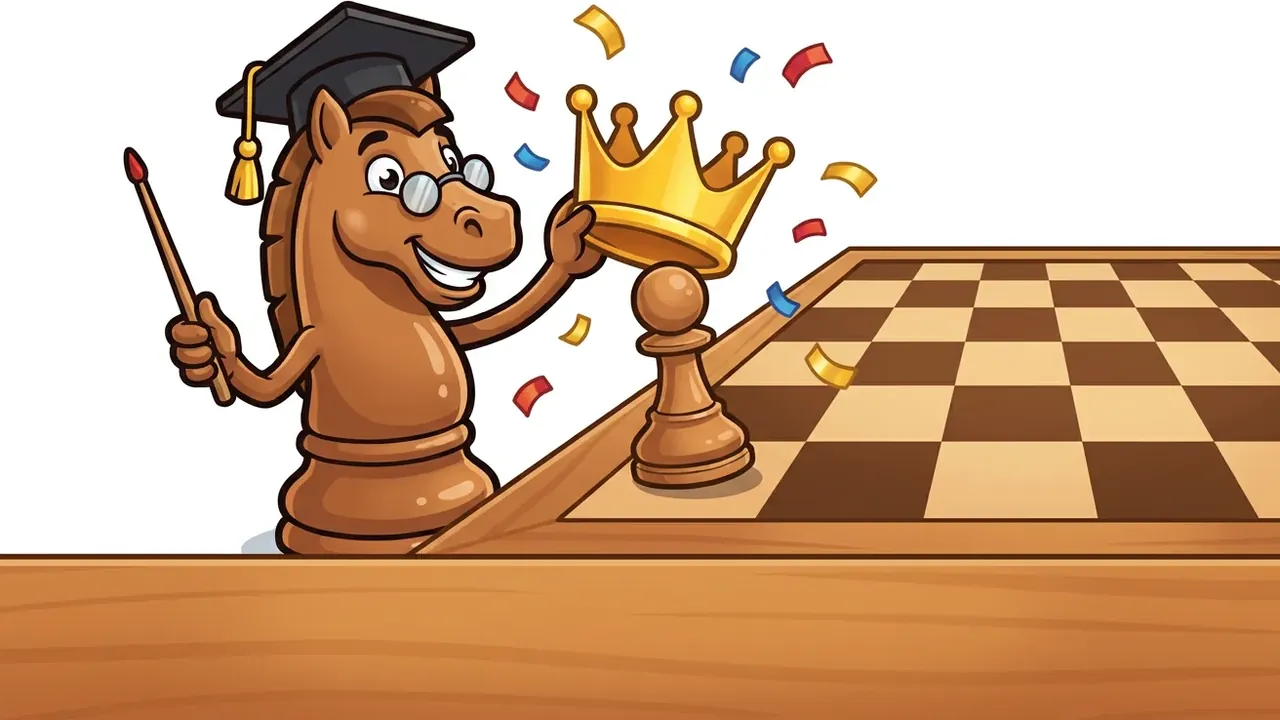
The pawn is the smallest piece in chess, but it has a dream: to reach the other side of the board. When it makes it, something special happens, because it stops being a pawn and becomes another piece. That is called promotion (or crowning). It is one of the most fun rules for kids, because it turns an ordinary foot soldier into a powerful queen. This guide is for children aged 6 to 10 and the adults who teach them. If you need to remember how the pawn advances before going on, there is how chess pieces move.
The essentials in one minute
- When a pawn reaches the last row (row 8 for White, row 1 for Black), it must become another piece.
- It can be a queen, rook, bishop or knight, always of the same colour. It cannot stay a pawn or become a king.
- You can choose even if you already have that piece: you can have two, three or more queens.
- Almost always you choose the queen, because she is the strongest. But sometimes another piece is better.
- It happens on the same move as arriving: the pawn disappears and the new piece takes its square.
- The new piece acts from the next move on, and it can give check or checkmate straight away.
What it is: the pawn that reaches the end
A pawn only goes forward, never back. If nobody stops it, one day it reaches the far row. That moment feels like a little party: the pawn leaves the board and in its place comes a new piece, whichever you choose, with its own movement rules.
If it chooses a queen here, the new piece appears on a8 and, in this case, gives check to the black king along the whole row.
Promotion is compulsory: if the pawn reaches the last row, you must choose. There is no "I will leave it as a pawn" and you cannot wait to decide later. And it is not a prize for capturing: you also promote when you capture diagonally and land on the last row.
Why it is almost always a queen
The queen is worth 9 points, against 5 for the rook and 3 for the bishop and the knight. She moves like a rook and a bishop together. So choosing a queen is the strongest option the vast majority of the time.
Kids often ask "can I have two queens?" Yes. A player can have three, four or more queens if they promote many pawns. On a physical board, since only one queen comes per side, you use an upside-down rook or borrow a queen from another set. It is part of the fun.
Typical kids' mistake: letting the pawn reach the last row and freezing, not knowing what to choose, or wanting to "leave it as a pawn just in case." If it arrives, it is promoted, no way round it.
Memory trick: "pawn at the end, queen on the throne." When the pawn arrives, think "queen?" first, and only then ask whether another piece is better.
Mini exercise: put a pawn on row 7, with the two kings far away. Ask the child to take it to the end and say out loud which piece they choose and why.
When another piece is better: underpromotion
Choosing something other than a queen is called underpromotion. It is rare, but sometimes it wins the game. There are three cases.
The knight
The knight is the only piece that moves differently from all the others, and that makes it perfect for giving check and attacking two pieces at once (a fork, explained in the article on the fork). Look at this position, with White about to promote.
With a queen on b8 nothing special happens: the black king and rook are not in danger. But with a knight on b8, the move gives check to the king on d7 and attacks the rook on a6 at the same time: the king has to move and White captures the rook.
The rook or the bishop
Another reason is to avoid stalemate (a draw): a situation in which the opponent cannot move but is not in check. Look at this position, with a white pawn one step from promoting and a very restricted black king.
Promoting to a queen leaves the black king with no free square and no check: the result is a draw, not a win. With a rook on b8, on the other hand, the black king can go to a7 and the game goes on, with an advantage for White. In situations like this, a weaker piece wins more than a queen. It is explained in chess draws.
Typical mistake: promoting to a queen without checking whether the opponent is left without moves. Before promoting, ask yourself: "after my move, does the enemy king have any square to go to?" If it has none and is not in check, careful!
Memory trick: "before promoting, look at the enemy king." Two seconds of checking saves a won game.
Mini exercise: set these positions on the board and have the child try all four options (queen, rook, bishop, knight) to see what happens with each.
Small notes on the rule
- You promote in any column, not only the pawn's own. If it captures diagonally onto the last row, it promotes on that square.
- You cannot promote to a king or a pawn. And the new piece is the same colour as the pawn.
- The chosen piece does not need to have been captured before. You can have two queens even if you have lost none.
- The new piece cannot move on the same turn. It appears, and that is it. From the next move it acts normally, although it can give check as soon as it appears.
- Once the chosen piece is placed, you cannot change your mind.
How to practise it
A very good way to learn promotion is to play simple endgames: for example, a king and a pawn against a lone king. The child tries to push the pawn to the last row without the enemy king catching it. After that, against the app with a coach that rates every move, you can see when a promotion wins and when there is a better way.
If you are starting out, the course with the knight professor in Chess Academy Kids takes you step by step through how each piece moves and how to reach checkmate, and the puzzles with hints give practice without pressure. And if you are one of those who have never touched a board, see I don't know chess and I want to teach my child.
To complete the pawn's special rules: en passant and castling.
Can a pawn promote to a king?
No. The options are queen, rook, bishop or knight, always the same colour as the pawn. You also cannot leave it as a pawn: promotion is compulsory when it reaches the last row.
Can you have more than one queen?
Yes. If you promote a second pawn to a queen, you will have two. On a physical board you usually use an upside-down rook or a queen from another set to represent her.
Why is a knight sometimes better than a queen?
Because the knight moves in a unique way and sometimes gives check and attacks another piece at the same time, or stops the opponent from being stalemated. These cases are rare: the vast majority of the time, the queen is the best choice.