Learn chess
Chess draws: stalemate, repetition, 50 moves and more
How a chess game ends in a draw: stalemate, threefold repetition, the 50-move rule, insufficient material and agreement, explained for kids with diagrams.
Not every chess game ends with a winner. Sometimes the result is a tie, which in chess is called a draw. For kids it is one of the hardest parts to accept: "I was winning and I drew!" Understanding when it happens, and above all how to avoid one you do not want, is a skill in its own right. This guide explains the five kinds of draw with the FIDE rules (the international federation), with diagrams, and is meant for children aged 6 to 10 and those who teach them. If you need to review the basics, start with chess rules for kids.
The essentials in one minute
A game ends in a draw when:
- Stalemate: the player to move is not in check but has no legal move.
- Threefold repetition: the same position appears three times, with the same player to move.
- The 50-move rule: 50 moves by each side pass without a capture or a pawn move.
- Insufficient material: there are not enough pieces left for anyone to give mate.
- Agreement: both players accept the tie.
1. Stalemate: the most surprising draw
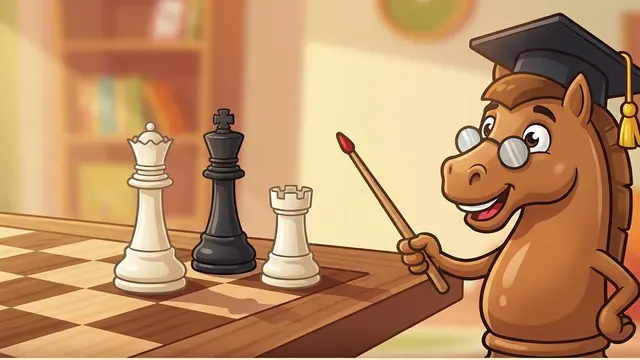
There is a simple rule: you cannot pass. If it is your turn, you have to move. But what if you have no legal move and your king is not in check? Then you are stalemated and the game is a draw at once, even if your opponent is a queen up.
See why: the queen on c7 watches b7, b8 and a7 (the white king on b6 also watches a7), and the black king is not attacked. The side to move cannot move. If it were check, it would be mate and White would win; without check, it is a draw. The difference is a single square, and you can see the comparison in check and checkmate.
Typical mistake: the player who is winning gets excited, corners the enemy king and leaves him with no moves... without noticing it is not check. It happens a lot with an extra queen.
Memory trick: before moving, the winner's question: "will my opponent have any move after mine?" If he has none and it is not check, change your move. Leaving the enemy king a free square avoids stalemate.
Mini exercise: set up a white queen and king against a black king in a corner. The child with White must give mate without stalemating. Repeat from different starting squares: it is a classic exercise.
2. Threefold repetition: the same position, three times
If the same position on the board appears three times in the game, with the same player to move and the same possible moves (for example, the same castling rights), either player can claim a draw. The repetitions do not have to be consecutive: many moves can have gone by between them.
It often happens when a player gives continuous check (perpetual check): the opponent cannot escape and the attacker repeats the checks. It is the way to save a lost game. It also happens when both players shuffle a piece back and forth without doing anything new.
Typical mistake: thinking you have to repeat the same move three times in a row. No: what counts is the whole-board position, and it can recur at separate moments. Another mistake: believing the game ends by itself on the third repetition. In the official rules you have to claim it; if nobody claims, the game goes on. (On the fifth repetition, the draw is automatic.)
Memory trick: "if the board is the same again, it counts as one." A practical way to keep watch is to write down the moves, or simply notice whether the pieces are going round in circles without progress.
Mini exercise: play a game with only kings and rooks. If you see both of you moving a rook back and forth, count out loud how many times the position repeats.
3. The 50-move rule
If 50 moves by each side (100 moves in total, counting White's and Black's) go by with no capture and no pawn move, either player can claim a draw. Pawn moves and captures are "irreversible": a pawn cannot go back, and a captured piece does not return. If neither happens for a long time, the game is not progressing.
This rule shows up mostly in endgames that are hard to win, and it comes into play when a player does not know how to give mate with the pieces they have. If there is a pawn to move or a piece to capture, the move counter goes back to zero. (And after 75 moves by each side with no captures or pawn moves, the draw is automatic.)
Typical mistake: counting 50 moves in total instead of 50 for each side, or not restarting the count when a pawn moves or a capture is made.
Memory trick: "pawn or capture, I start again." Those two events set the counter to zero.
4. Insufficient material: when mate is no longer possible
If there is no way on the board for either player to give checkmate, however badly the other plays, the game is automatically a draw. It happens in these cases:
- King against king.
- King and bishop against king.
- King and knight against king.
- King and bishop against king and bishop, with both bishops on the same colour of square (both light-squared, or both dark-squared).
Note: king and two knights against king is not an automatic draw, because in theory the opponent could blunder into mate, but you cannot force a win. It is a rules detail almost nobody needs at the beginning.
Typical mistake: thinking a king and a pawn against a king is a draw. With a pawn you can win, because it can promote and become a queen (see pawn promotion).
Memory trick: "no pawns, and a single small piece, no mate." That is why it ends in a draw.
5. Draw by agreement
Both players can agree to call it a draw. In tournaments, it is offered when making a move and the opponent may accept or decline; it cannot be forced. With children, it is a good moment to talk about sportsmanship: accepting a draw when you are worse is a reasonable gesture, and declining it when you are winning is normal. A good house rule: offer a draw only when you truly think the position is level.
Typical mistake: asking for a draw out of frustration when you are losing, with the other player not seeing why. The opponent does not have to accept.
What to do if you do not want a draw
The best prevention is knowing why they happen. To avoid stalemate, always leave the enemy king a move. To avoid repetition, change plan if you see you are repeating. For the 50-move rule, move a pawn or capture something when needed. And for insufficient material, keep at least a pawn or a major piece.
Practising is the most natural way to remember it: in Chess Academy Kids, the course with the knight professor explains checkmate step by step, and when you play against the app with a coach you see whole games, with a rating for each move. The puzzles with hints let you review each mate without pressure. And if you are one of the adults learning at the same time as your child, see I don't know chess and I want to teach my child: drawing by stalemate is one of the things that happens to all of us.
Draws and sportsmanship
Kids who want to win all the time find it hard to accept a draw. It helps to tell them that drawing against a stronger opponent is a good result, and that letting a win slip through stalemate is a mistake that happens to everyone, strong players included. What matters is to learn: write the position down, talk about it together and try again.
Is a stalemate a win for the player who causes it?
No. It is a draw, even if the stalemated player is in a very bad position. To win you have to give checkmate: the king must be attacked with no escape. Stalemate happens when there is no check and also no possible move.
Is threefold repetition automatic?
Under FIDE rules, at three repetitions a player has to claim the draw; if nobody claims, the game continues. At five repetitions of the same position, the draw is automatic. At home, with children, you can agree to say so as soon as it happens.
How many moves does the 50-move rule count?
It counts 50 moves by each player, that is, 100 in total, with no capture and no pawn move. If neither has happened in that time, either player can claim a draw. At 75 moves by each side with no capture or pawn move, the draw is automatic.