Learn chess
Chess rules for kids: a complete beginner's guide
The rules of chess explained to kids aged 6 to 10 and the parents teaching them: the board, setup, goal, turns and piece values, with diagrams and exercises.
If someone told you chess is complicated, they told you only half the story. It is true that you can play for a lifetime and keep learning. But the rules you need to get started fit on one page, and a six-year-old can learn them in a handful of afternoons. This guide is the whole map: the board, where each piece goes, what you are trying to do, how players take turns and what each piece is worth. After that, each topic has its own article with more detail.
It is written for two readers at once: the child who is going to play, and the parent, grandparent or older sibling who sits beside them and may never have moved a bishop. If that is you, relax: not knowing chess does not stop you from teaching it. You learn together.
The essentials in one minute
- The board has 64 squares, 8 by 8, alternating light and dark.
- Each player starts with 16 pieces: 8 pawns, 2 rooks, 2 knights, 2 bishops, 1 queen and 1 king.
- White and Black take turns, one move each, and White always goes first.
- You win by giving checkmate: attacking the opponent's king so it cannot escape.
- The king is never captured: the game ends earlier, with checkmate.
- If nobody can win, the game ends in a draw (a tie).
The board: 64 squares and a trick to set it up
The board is a square of 8 rows and 8 columns. Columns are named with letters, a to h, and rows with numbers, 1 to 8. So every square has a name, like in the game of Battleship: e4 is column e, row 4. White's pieces start on rows 1 and 2 (the bottom) and Black's on rows 7 and 8 (the top).
Look at the two highlighted squares, a1 and h1. Here is a trick so you never set the board up backwards: each player has a light square in their right-hand corner. If your right-hand corner is dark, turn the board around. It is a very common mistake, and that one sentence prevents it.
The starting setup: every piece in its place
The back row (row 1 for White, row 8 for Black) holds, from left to right: rook, knight, bishop, queen, king, bishop, knight, rook. In front of them, a full row of pawns.
Two rules to remember where the queen and king go:
- The queen likes her own colour: the white queen starts on a light square (d1) and the black queen on a dark one (d8).
- Queen faces queen, king faces king: each piece stands opposite its twin. The white queen is on column d, facing the black queen; the white king is on column e, facing the black king.
Typical kids' mistake: swapping the king and the queen. The rule above gives it away at once: if your queen is on a square of a different colour, swap her with the king.
Memory trick: "the queen loves her colour." White queen on a white square, black queen on a black square.
Mini exercise for home: set up the pieces without looking at any picture. The adult deliberately makes two mistakes and the child has to find them. It is a favourite game for many kids: catching a grown-up making an error.
The goal: checkmate
In chess you do not win by capturing the most pieces, or by getting somewhere first. You win when the opponent's king is in check (attacked) and there is no way to save it. That is called checkmate. At that moment the game ends and the player who gave mate wins.
A short example. It is the fastest checkmate possible, only two moves for each side (White plays terribly on purpose):
This diagram is the final position of the so-called fool's mate. White has moved the f- and g-pawns and opened the way for the black queen to reach the king. There is no way out: the king cannot move, no piece can block, and nobody can capture the queen. You can see it in depth in check and checkmate.
Typical mistake: thinking you have to "eat the king". It is never captured: when it is attacked and has no defence, the game is over.
Memory trick: checkmate is a door closed on every side: the king cannot leave, block or remove the attacker.
Mini exercise: before each move in every game, ask the child "is my king attacked?" and "is the other king attacked?" It is the question that saves the most games.
Turns: one move each
White moves first. After that, each side plays once, alternating, until the end. You cannot pass: even if you do not like any move, you must move something (in fact, that obligation is why a kind of draw called stalemate exists, which we cover in chess draws).
On each turn you move one piece, with one exception: castling, where the king and a rook move together (castling explained). If the destination square holds an enemy piece, you capture it: the enemy piece leaves the board and yours takes its place. If it holds one of your own pieces, you cannot go there.
There is a tournament rule worth knowing: touch-move. If you touch a piece intending to play it, you must move it (if it can move). At home you can be more relaxed with the youngest players, but getting used to thinking before touching helps a lot. Once your move is done, it is the other player's turn. Each piece moves differently: see how chess pieces move.
Typical mistake: moving twice in a row because the opponent is slow to answer, or thinking you can pass.
Memory trick: "one, one, one." One move, one piece, one turn. Then it is the other player's turn.
Mini exercise: play a game where a small object marks whose turn it is (a souvenir pawn that goes from one side to the other). Whoever holds it, moves.
What each piece is worth
Pieces are not all worth the same. There is an informal scale, which is not a rule of the game but a help for deciding whether a trade is a good idea:
| Piece | Approximate value |
|---|---|
| Pawn | 1 |
| Knight | 3 |
| Bishop | 3 |
| Rook | 5 |
| Queen | 9 |
| King | not counted (it cannot be lost) |
With this table, if you trade your knight (3) for an enemy rook (5), you come out ahead. If you give up your queen (9) for a pawn (1), it is a bad deal... unless that move gives checkmate, because checkmate is worth more than everything else.
Typical mistake: trading the queen (9) for a rook (5) because "they are both big pieces." The queen is worth almost double: look after her much more carefully.
Memory trick: "one, three, three, five, nine": pawn, knight, bishop, rook, queen. Sing it like a little song and it sticks forever.
Mini exercise: pull pieces at random from a bag and ask the child what each is worth. Then compare two piles and say which is worth more.
How to practise without getting bored
At ages 6 to 10, what works best is mixing three things: a short explanation, a concrete exercise and a game. A good rhythm is 15 minutes, no more, stopping while the child still wants to carry on.
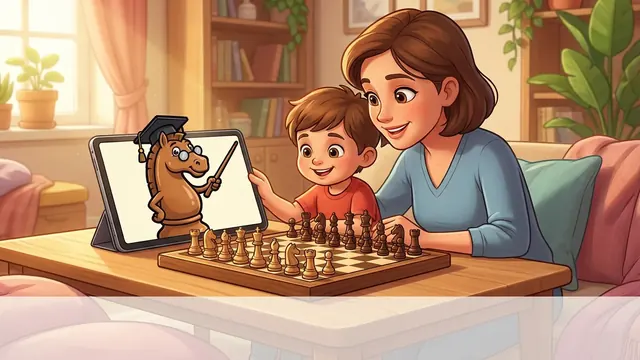
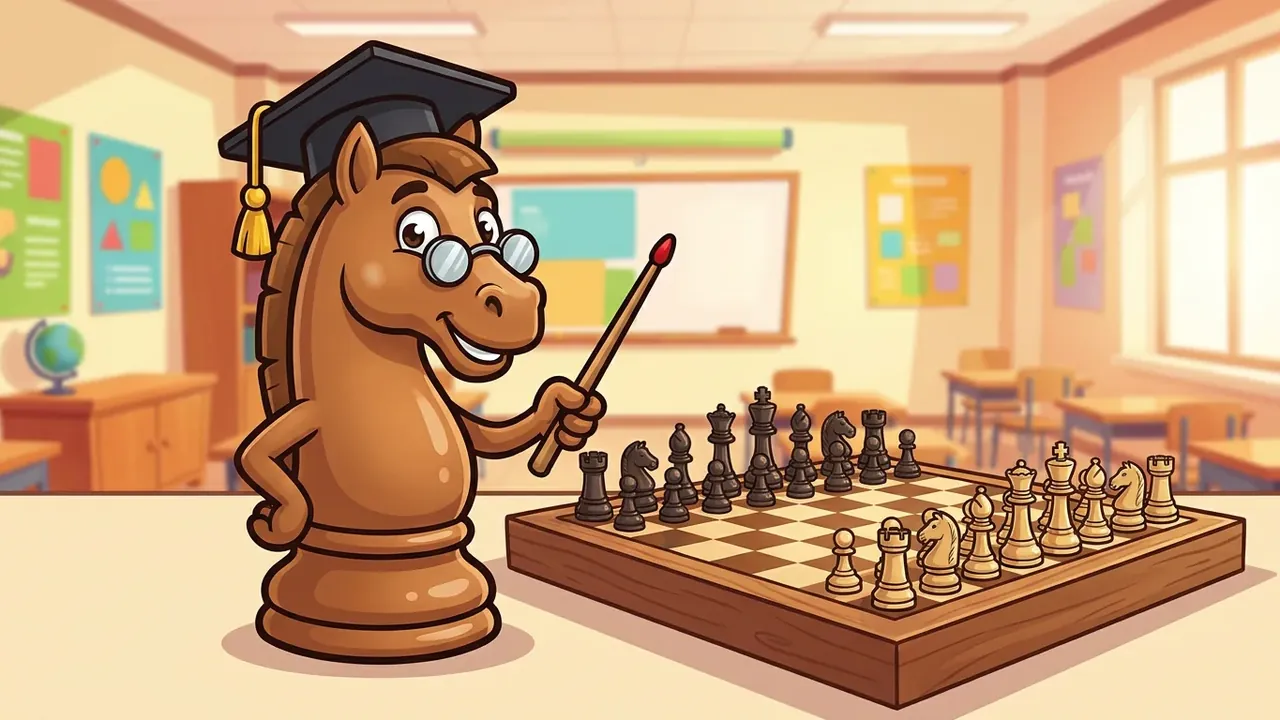
Chess Academy Kids does exactly that. A talking knight professor explains each piece in the step-by-step course, the puzzles with hints lock in what was learned, and you can play against the app with a coach that rates each move. The first module of the course is free. It does not replace playing on the board at home with you, but it does mean that an adult who does not know chess has a patient partner who explains each thing.
If you want to go beyond the rules, these are the natural next steps:
- How chess pieces move: one by one, with diagrams.
- Check and checkmate: the goal of the game, with typical mates.
- Castling, en passant and pawn promotion: the three special rules.
- Draws: how a game ends in a tie.
A note of honesty
Learning the rules does not make you a player. It is normal that in the first few days a child loses pieces without noticing, forgets that a pawn captures diagonally or leaves the king in check. That is part of the path and does not mean a lack of talent. What matters is that you play often and for short sessions, and that chess feels fun. The rest comes with practice.
At what age can a child learn the rules of chess?
Many children grasp the basic rules between 5 and 7, and some from 4 if it is presented as a game, one piece at a time. The important thing is not to rush: it is better to master how each piece moves than to memorise everything in one afternoon.
Do I need to know chess to teach a child?
No. If you know the rules in this guide you can start. Learning alongside the child even has an advantage: they see that making mistakes is normal and that you can enjoy playing badly at first.
How long does it take a child to learn to play?
With 15 or 20 minutes three or four times a week, many children aged 6 to 8 move every piece correctly within two or three weeks. Giving checkmate smoothly usually takes a bit longer. Every child goes at their own pace and there is no guaranteed timeline.