Learn chess
How chess pieces move: a guide with diagrams for kids
How every chess piece moves: pawn, rook, bishop, knight, queen and king, with one diagram per piece, the typical mistake kids make and a memory trick for each.
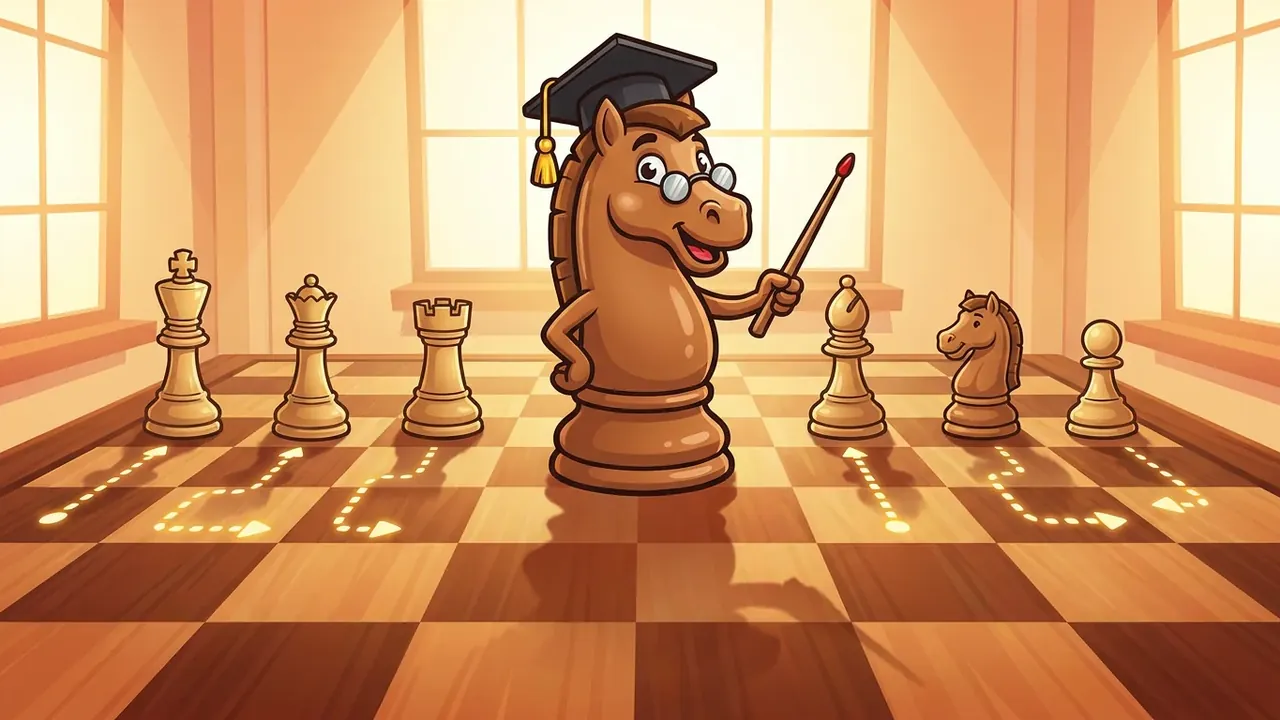
There are six kinds of pieces and each moves in its own way. It sounds like a lot, but it is quick to learn if you take one at a time with a board in front of you. In this guide you will see every piece with a diagram: the yellow squares are where it can go and the arrows show some of its moves. It is ideal for kids aged 6 to 10 and for the adult playing with them, even if it is the first time they have touched a board. If you would like the big picture first, start with chess rules for kids.
The essentials in one minute
- Rook: in straight lines, along rows and columns, as many squares as it likes.
- Bishop: diagonally, as many squares as it likes, and always on the same colour of square.
- Queen: like a rook and a bishop combined.
- King: one square in any direction, and never onto an attacked square.
- Knight: jumps in an L shape and is the only piece that can jump over others.
- Pawn: moves forward but captures diagonally; on its first move it can go two squares.
- No piece can end its move on a square holding one of its own pieces, and on a square with an enemy piece, it captures.
The golden rule for every piece
Before looking at each one, two shared ideas. First: capturing means moving onto the enemy piece's square, and that piece leaves the board. You do it with the same piece and the same movement (with a single exception, the pawn, which captures differently). Second: only the knight jumps. Rook, bishop and queen need a clear path: if there is a piece in the way, they stop before it (or capture it, if it is an enemy, but they do not go past).
The rook: straight lines
The rook moves in a straight line, along its row or column, as many squares as it likes, as long as nothing is in the way.
Typical mistake: moving the rook diagonally, or changing direction half way (going two squares forward and one to the side). A rook move is one straight line.
Memory trick: the rook is a train that only follows its tracks: straight, no curves. It is also called "the castle" because of its shape.
Mini exercise: put a rook in the middle of the board and a few pawns as obstacles. Ask the child which squares it can reach and which ones each obstacle blocks.
The bishop: diagonals, always the same colour
The bishop moves diagonally, as many squares as it likes. Since it only moves diagonally, it never changes colour: a bishop that starts on a light square stays on light squares for the whole game. That is why each player has two: one for each colour.
Typical mistake: trying to change the bishop's colour ("what if I move it to the dark square next to it?"). You cannot: a light-squared bishop is light-squared forever.
Memory trick: the bishop is a skater who only glides diagonally: always "in its own lane", never changing colour.
Mini exercise: put a bishop on the board and ask the child to take it to the opposite corner in one move, and then to a square of a different colour (impossible: that is where they learn why).
The knight: the L-shaped jumper
The knight moves in an L shape: two squares in one direction (straight) and one more to the side. It is the only piece that jumps over others, whether yours or the enemy's, and that makes it very useful in the first moves, when the centre is full of pawns. It always lands on a square of a different colour from the one it left. If an enemy piece is on the landing square, it captures it.
Typical mistake: counting "three squares" wrongly, or thinking it cannot jump over its own pawns. It jumps over everything.
Memory trick: draw an L in the air. Two steps straight, one to the side. Many kids remember "two and one", or the knight in the course, who explains each jump out loud.
Mini exercise: "the knight's tour": put the knight in a corner and find how many moves it takes to reach the opposite corner. It is great visual training.
The queen: the most powerful piece
The queen moves like a rook and a bishop at the same time: in a straight line or diagonally, as many squares as she likes. She is the strongest piece, which is why she is worth 9 points.
Typical mistake: bringing the queen out too early and losing her to a small piece that hunts her. Being powerful does not mean being invincible: she moves freely, but the opponent can attack her too.
Memory trick: "queen = rook + bishop." When in doubt, ask yourself: could a rook or a bishop do this? If so, the queen can.
Mini exercise: put the queen in the middle of the board and scatter eight pawns around. Ask the child to count how many of them she can capture in a single move.
The king: the piece to protect
The king moves just one square in any direction: straight or diagonally. He looks weak, but he is the most important piece: if you lose him (if he is checkmated), you lose the game. That is why the king cannot move to a square attacked by an enemy piece, nor get so close to the other king that they touch.
Typical mistake: leaving the king on an attacked square, or moving him onto one without noticing. The game does not allow it: the move would be illegal. If your king is attacked, that is check, and you have to get out of it (see check and checkmate).
Memory trick: the king is "the one who takes baby steps": only one, but in any direction. And when the child wants to move him a lot, remind them the whole game is about protecting him.
Mini exercise: "the king in danger": place the king and an enemy rook. The child marks the squares the king cannot go to because the rook attacks them.
The pawn: the smallest and the most special
The pawn has three different rules, which is why it is the piece kids get wrong most often:
- It moves forward one square, never backwards. It cannot capture forward: if a piece is in front, it is blocked.
- It captures diagonally, one square forward and to the side. Only if an enemy piece is there.
- On its first move it can advance one or two squares, if both are free.
Typical mistake: capturing forward (as if it were a rook) or moving diagonally without a capture. Kids also forget that the double step only works the first time.
Memory trick: "walks straight, eats sideways." Five words that sum up the whole pawn.
Mini exercise: line up several pawns and put a couple of enemy pieces diagonally in front. Ask the child which ones can be captured and which pawns are blocked.
The pawn has two more powers that are learned later, once the above is solid: en passant and promotion, which lets it reach the other side and become another piece.
How to review it at home
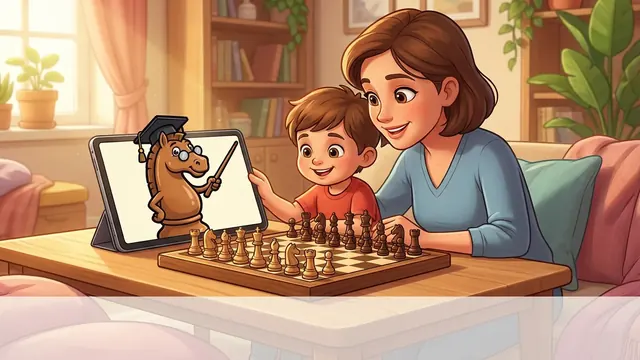
One method that works: a nearly empty board, one piece in the middle and the question "where can it go?" The child points at the squares and you check. In a week of 10 minutes a day, all six pieces stick.
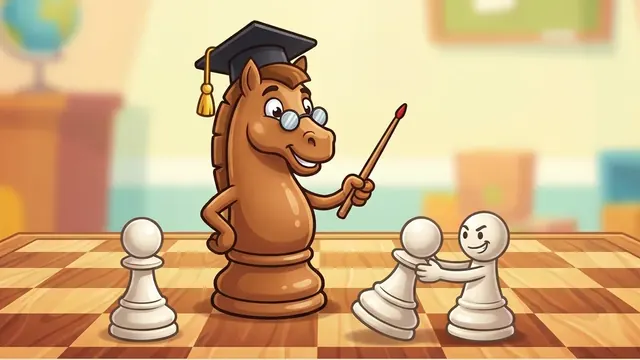
It also helps to have a companion who explains the pieces out loud and lets the child practise. In Chess Academy Kids, the course with the knight professor devotes its first lessons to how each piece moves, and the puzzles with hints let you practise without pressure. If you are one of the adults who has never played, see I don't know chess and I want to teach my child: there is a concrete path. And when all the pieces move easily, the next step is to play against the app with a coach.
Why is the knight the hardest piece?
Because its L-shaped jump does not look like any other piece's and cannot be seen as a line. It helps to practise on a nearly empty board and mark with counters the eight squares it can jump to from different places.
Which piece is best to start teaching with?
The rook, because it is the simplest (only straight lines), followed by the bishop and the queen. The knight and the pawn, with their special rules, are usually left for later. Keeping sessions to 10 or 15 minutes helps avoid overload.
Can a piece jump over another?
Only the knight. The rook, bishop and queen need a clear path, and the king and pawn move so little that they never get to jump. The knight jumps over both its own pieces and the enemy's.