Learn chess
En passant in chess explained for kids
What en passant is, when you can do it, why the rule exists and how to remember it, with diagrams, typical mistakes and a home exercise for kids and parents.
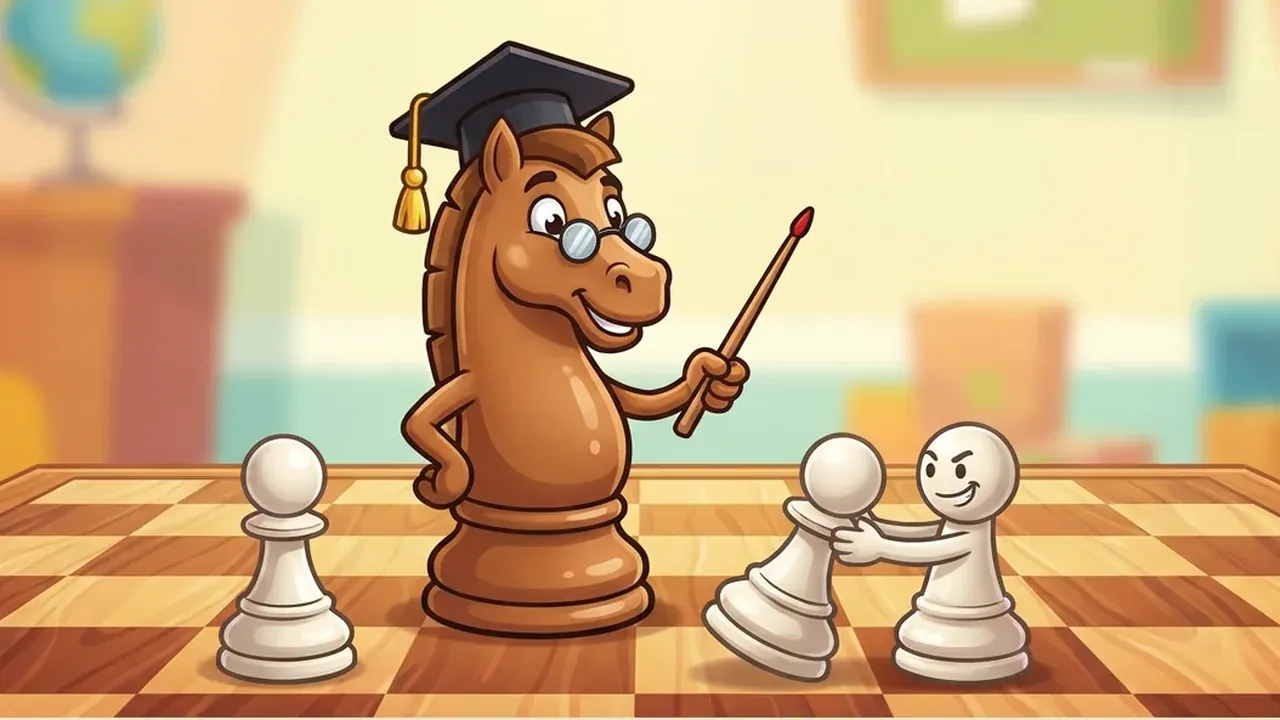
En passant (French for "in passing", pronounced "on pa-SAHN") is the rule that puzzles kids, and many adults, the most. One day your opponent moves a pawn and suddenly your pawn can capture it in a way that looks like a trick. It is not a trick: it is a rule with a very clear reason, and you can understand it in five minutes with a board in front of you. This guide is for children aged 6 to 10 and those who teach them. It helps to know how pawns move first; if not, review it in how chess pieces move.
The essentials in one minute
- Only a pawn can do it, and only against another pawn.
- The capturing pawn must be on its fifth row (row 5 for White, row 4 for Black).
- The enemy pawn must have just advanced two squares in one go from its starting square and landed right beside yours.
- You capture as if the enemy pawn had advanced only one square: your pawn lands on the square the enemy skipped.
- You can only do it on the very next move. If you do not do it right away, you lose the right.
- It is optional: nobody forces you.
Why this rule exists
A pawn can advance two squares on its first move. That used to allow something players found unfair: slipping past an enemy pawn by jumping ahead of it. Imagine your pawn is already on the fifth row, ready to attack the pawns next to it. If the enemy advances two squares and lands beside you, it has sneaked past without you being able to do anything. En passant fixes that: it lets you capture it as if it had stopped on the in-between square, the one it skipped.
In one sentence: the double step cannot be used to dodge a pawn.
Step by step, with diagrams
Say White has a pawn on e5 and Black a pawn on d7 that has not moved. It is Black's turn.
If Black advances just one square (d7 to d6), the white pawn can capture normally, diagonally (exd6). But if Black advances two squares in one go (d7 to d5), the black pawn lands right next to the white one, on d5. Before this rule, the white pawn could have done nothing.
White plays the pawn from e5 to d6. The black pawn on d5 disappears from the board (even though the white pawn did not land on its square, but on d6, the one it skipped).
Notice the oddity: the white pawn captures by moving to an empty square (d6), and the captured piece is on a different square (d5). It is the only capture in chess where the captured piece is not on the destination square.
The conditions, one by one
- Your pawn is on its fifth row: row 5 if you play White, row 4 if Black. On any other row there is no en passant.
- The enemy pawn has just advanced two squares, right now. If it advanced one, or two long ago, it does not count.
- It ends up beside yours, on the same row and in an adjacent column.
- You do it immediately, on your next move. If you move something else, the chance is gone forever.
And one condition people forget: the move cannot leave your own king in check. If moving the pawn opens a line of attack against your king, you cannot do it (as with any move).
The typical mistakes of kids (and some adults)
There are three very common ones:
- Doing it with another piece. En passant exists only between pawns. A knight or a queen cannot do it.
- Doing it late. "Wait, first I want to move something else", and by the next move it is too late. It is a "now or never" rule.
- Putting the pawn on the wrong square. The capturing pawn does not take the captured pawn's place: it goes to the square the enemy pawn passed through, and the captured pawn is removed from the board.
Memory trick: think of the pawn as someone who ran past the in-between square. Your pawn catches it in passing. Hence the name: en passant means "in passing."
Another trick: "the pawn wants to sneak by, I catch it." And a short phrase to remember the conditions: "fifth row, two steps, right now."
Mini exercise for home
Try this with a position containing only kings and pawns:
- Put a white pawn on e5 and a black one on d7 (the kings on their squares). The player with Black moves d7 to d5.
- The player with White decides whether to capture en passant. Do it, and say out loud where each pawn ends up.
- Repeat, but this time the black pawn advances one square (d6) and then another. The child should notice that there is no en passant now.
- Switch sides: now White advances two squares (for example d2 to d4) and a black pawn on e4 captures en passant on d3.
After four or five repetitions it usually sticks.
How to tell if the game lets you capture en passant
A visual clue: your pawn is on row 5 and an enemy pawn has appeared on the same row in the next column. Before moving, ask yourself: "did that pawn just arrive by a double step?" If the answer is yes, it is your chance. In a real game, look at what your opponent moved last: if it was that pawn, you can capture it.
To practise it, nothing beats playing whole games, because it is a situation that comes up from time to time. In Chess Academy Kids, the course with the knight professor and the games against the app with a coach let you practise full games, with a coach who explains why a move is good or bad. If you are an adult who has never played, do not worry if this rule is hard: that is normal. Learning alongside your child has this advantage: you both make mistakes and you both remember.
To complete the pawn's special rules, see pawn promotion and castling.
Is en passant compulsory?
No. It is an option: you can do it or ignore it. But if you ignore it, the chance disappears on the next move. Sometimes it is better not to capture, if the move leaves your position weak.
Can you capture a piece that is not a pawn en passant?
No. Only pawns do it and only pawns can be captured that way. Rooks, bishops, knights and queens have nothing similar.
What if the enemy pawn advances one square, and then another?
Then there is no en passant. The rule only works when the pawn advances two squares at once, from its starting square, and you can capture it right at that moment.