What worries parents
I don't know chess and I want to teach my child: a 4-week plan
You don't need to know chess to support your child. Learn together with a 4-week plan, 15 minutes a day and a knight professor that plays the teacher.
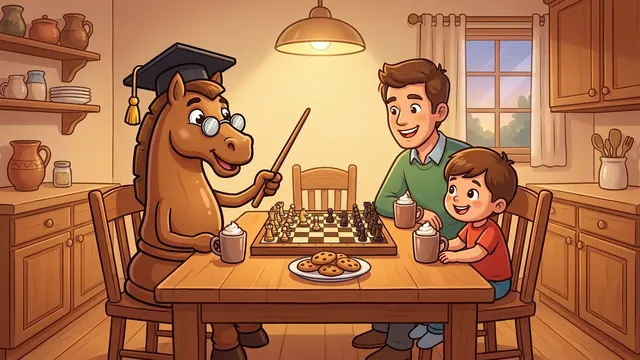
Imagine your child comes home from school saying a classmate showed them how the knight moves and they want to play with you. You vaguely remember that the bishop goes diagonally and that "the knight makes an L", and not much more. You feel embarrassed to say so. It probably sounds familiar: wanting to support an interest you have not mastered.
The good news: you do not need to know how to play to start. You need curiosity, a simple plan and the humility to learn at the same time. In fact, many children enjoy it more when the adult is learning too.
Key points
- You do not need to be a good player: being one lesson ahead, or level with them, is enough.
- Learning together has advantages: your child can teach you, which reinforces what they know.
- With 15 minutes a day for four weeks you can learn the basic rules and play simple games.
- An app with a knight professor can act as the teacher; you provide company and encouragement.
- Do not expect them to learn in a weekend: patience matters more than method.
Why you do not need to be an expert
What a child of 5 to 8 needs to start is not a grandmaster. They need someone who sits with them, shows interest, can say "I don't know, let's look it up" and makes it a pleasant time. The rules of chess fit into one afternoon, and the rest is learned by playing.
Learning at home also has an advantage: there is no competition with other children. They can make mistakes, try and repeat without an audience.
And an honest warning: do not expect learning chess to raise their grades. Research on that kind of benefit is mixed, as we explain in benefits of chess for kids. Learn chess for what it is: a lovely game.
The 4-week plan (15 minutes a day)
The idea is to go step by step. Five days a week, 15 minutes, weekends free.
Week 1: the pieces and how they move
- Days 1 and 2: the board (64 squares, which corner goes on the right) and the pawn.
- Days 3 and 4: the rook and the bishop.
- Day 5: the knight ("jumps in an L", the piece children like most) and the queen.
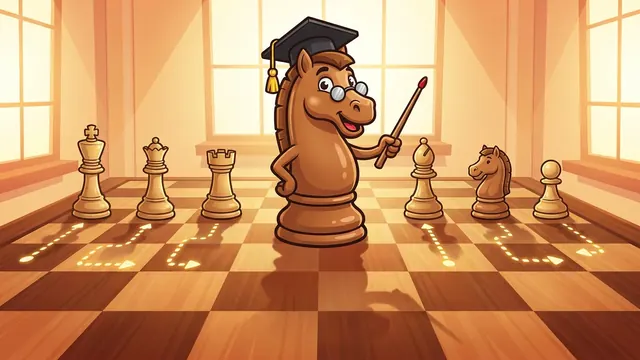
For each piece, let your child move it with their hand and make one mistake on purpose so they can correct you. See how chess pieces move to keep a reference handy.
Week 2: the aim of the game
- Days 6 and 7: the king and check.
- Days 8 and 9: checkmate (the game ends) with examples of mate in one move.
- Day 10: draws and stalemate, just the basics.
Check and checkmate for kids fits here. You do not need to memorise it: look at one example together each day.
Week 3: first games with an edge
- Days 11 to 13: games with few pieces (king and pawns against king, or queen against king) to practise checkmate.
- Days 14 and 15: the first full game with all pieces set up. It is normal for it to be chaotic and long: it does not matter if it is not finished.
Week 4: the basic ideas for a good start
- Days 16 and 17: control the centre and bring out the pieces (the knight before the rook). See controlling the center in chess.
- Days 18 and 19: "is my piece protected?" before every move.
- Day 20: the first "proper" full game. Celebrate it, whoever wins.
A diagram to start week 1: the starting position, with every piece in its place.
How the app plays the teacher
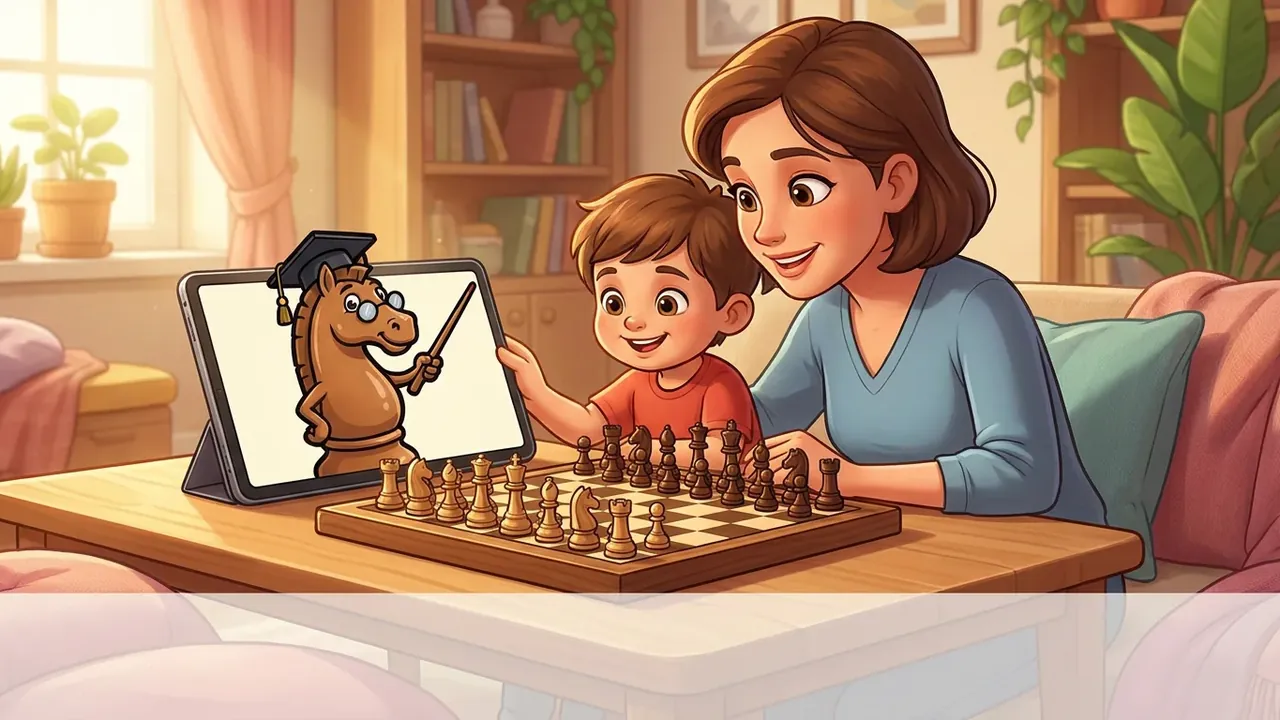
If you do not want to be the one explaining, or you are afraid of explaining it badly, let a virtual professor do it. In Chess Academy Kids a knight professor with a voice guides the course through lessons: how each piece moves, check and checkmate, tactics, how to find the best move and how to start well. The first module is free, so you can try without commitment. It is described in chess course with the knight professor.
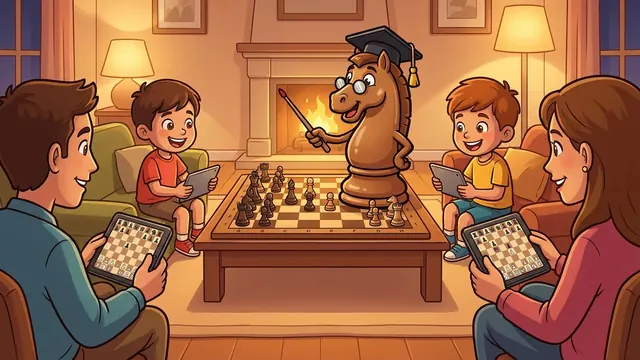
Your role, then, is not to teach the class but to be there: ask "what did it teach you today?", let your child explain it to you and play the game that follows the lesson. Afterwards, with playing against the app with a coach, your child plays and a coach rates each move and explains why, so you do not have to know whether it was good. And with the progress report for parents you see what they have practised even if you know no chess.
If there are two children or more, each can have their own profile: read family chess profiles per child.
What you can say when you do not know something
These phrases work better than pretending:
- "I don't know. Shall we look it up together?"
- "You explain it to me: why do you think that is a good move?"
- "I would have moved here, but your idea makes sense too."
- "You beat me. How did you see it?"
A child who explains an idea understands it better than one who only hears it. It is the "teach someone who doesn't know" technique, and it works with chess pieces.
Typical mistakes when learning together
- Wanting to speed up. If week 1 stretches to three, nothing is wrong.
- Correcting every move. Choose one thing per game.
- Playing only at the end of the day in a rush. Ten minutes every day beats an hour on Sunday.
- Comparing with other children. Everyone has their own pace; see what age to start chess.
What to do today
- Put the board somewhere visible (the living room table, not a cupboard).
- Tell your child that you are going to learn together and that you are a beginner, like them.
- Do the first 15-minute session: the board and the pawn. Nothing more.
- When you finish, ask what was the best part and what was the hardest.
- Mark the four weeks on the calendar. If a day does not work, no problem: carry on the next day.
More day-to-day ideas in how to teach chess at home.
What equipment you really need
Very little. A board of 64 squares and 32 pieces (wooden, plastic or cardboard, it does not matter), a fixed place to leave it and a kitchen timer. If the board stays set up on a low table, your child will see it and come over by themselves. The app saves you from hunting for puzzles and explanations, but a physical board is still the best way to see how the pieces move, especially with the youngest.
If your child is 4 or 5, lighten the plan: stretch it to eight weeks rather than four. At that age it is normal to play "pawn race" or "the knight jumps" and for real chess to come later.
In short
Not knowing chess is not an obstacle; it is a chance to learn next to your child. With 15 minutes a day and a four-week plan, you will both go from the pieces to a first full game, with a virtual professor who explains and you as company. What matters is not becoming good but making chess a time that belongs to the two of you.
Can I teach my child chess if I don't know how to play?
Yes. Being one lesson ahead, or level with them, is enough. Learning together has advantages: your child can teach you, and explaining something is a good way to understand it better. An app with a guided course can act as the teacher.
How long does it take a child to learn the rules of chess?
It depends on age and pace, but with about 15 minutes a day a month is usually enough to know the pieces and play simple games. There is no hurry: what matters is that it feels like a pleasant game.
What if my child already knows more chess than I do?
That is good news. Let them teach you and ask them to explain their moves. To keep progressing they can play against a coach, do puzzles or join a club, depending on what they enjoy.