Learn chess
Controlling the center in chess: the first big idea for kids
What the four central squares are, why they matter so much, and how to teach a child aged 6 to 11 to fight for the center with pawns and pieces.
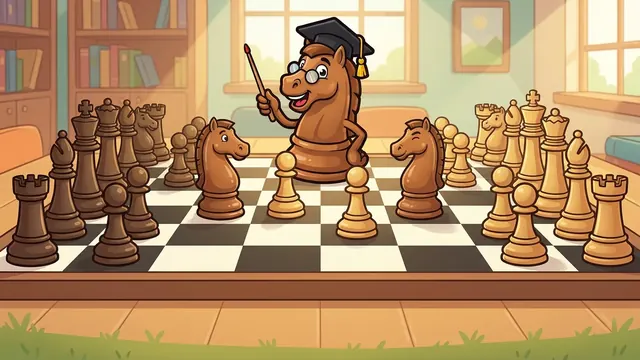
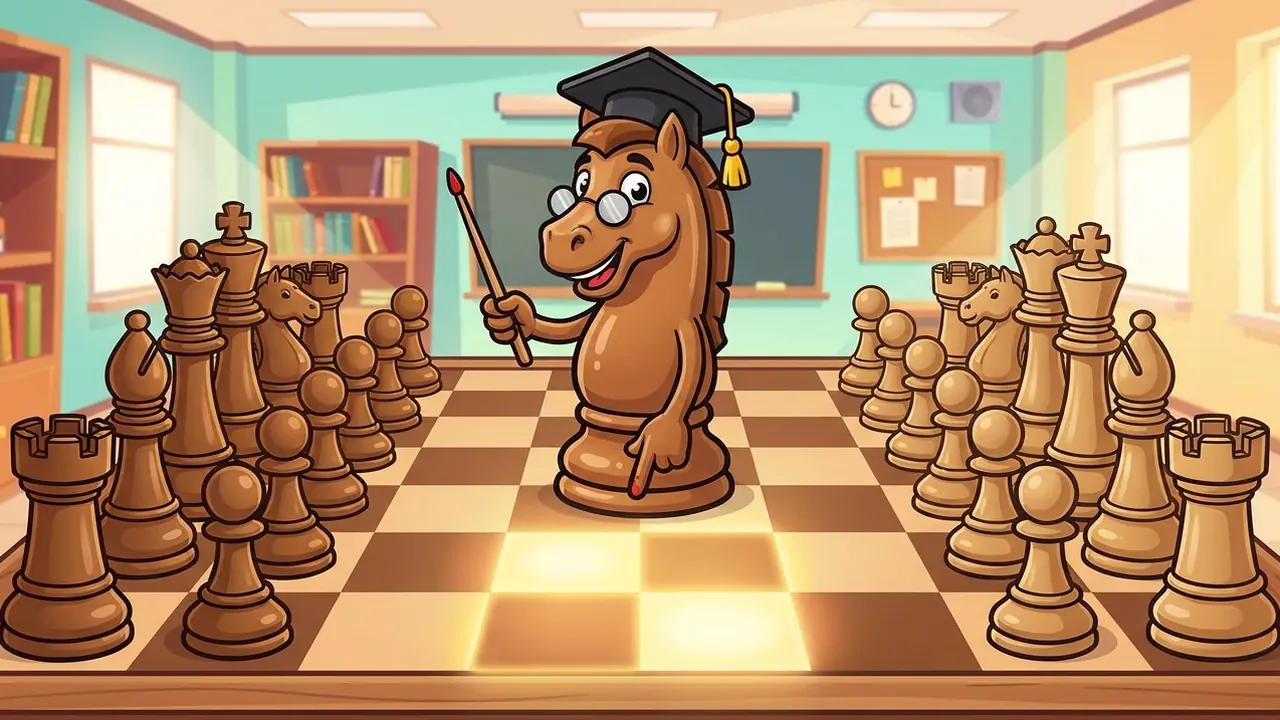
The center of the board is four squares: d4, e4, d5 and e5. Whoever controls them moves their pieces with more freedom and leaves the opponent with less room. It is the first strategy idea worth teaching a child, because it is easy to see and easy to repeat in every game.
Key points
- The center is d4, e4, d5 and e5, the four squares in the middle.
- A piece in the center reaches more squares than a piece on the edge.
- Controlling the center is not just standing on the squares: it also means watching them with pawns and pieces.
- The center pawns (the e and d pawns) are the first ones worth moving.
- Fighting for the center is pointless if you leave pieces unprotected: safety first, ambition second.
What controlling the center means, in one sentence
It means making your pawns and pieces rule the middle squares, either by standing on them or by watching them, so your pieces move easily and the opponent's cannot get in.
You can tell a child like this: the center is the town square. From the square you get to any street quickly. From a corner, you don't.
Why the center rules
Look at what happens with a knight. In the center it can jump to eight different squares. In a corner, only to two.
The same goes for the bishop, the queen and the rook: the closer to the center, the more squares they control. That is why the old saying goes: a knight on the rim is dim, and a knight in the center sees everything.
From the center your pieces can also head to either side of the board, the king side or the queen side, wherever they are needed. That flexibility is a big advantage.
Examples from a game
The simplest way to fight for the center is to move the d and e pawns two squares. For example, if White plays e4, Black plays e5 and White then plays d4, White already has two pawns right in the middle.
Center pawns do two jobs at once: they stand on squares and they watch the squares beside them. The pawn on e4 watches d5 and f5; the pawn on d4 watches c5 and e5. That makes it harder for the opponent to put pieces there.
You can also fight for the center from a distance, without occupying anything. If Black answers with d5, White can play c4 to attack that pawn and see whether it holds.
And when the opponent takes the center, you don't have to let them: you can attack it with a pawn or a piece. If Black plays d5 against e4, White can capture on d5 and, after the black queen recaptures, bring the knight out to c3 with a gain of time.
The typical mistake
Two mistakes keep coming up at this age.
- Moving edge pawns in the first moves. A pawn on the a or h file does almost nothing for the center. It looks useful because it "advances", but it has no effect.
- Filling the center with pawns and forgetting the pieces. Advanced pawns look nice, but if the pieces are still at home, the opponent attacks the pawns and wins them. Pawns and pieces go together.
There is a third, subtler mistake: believing that standing in the center is the same as controlling it. A pawn on e4 with no piece supporting it is an easy target. Two well supported moves are better than four loose ones.
How to spot it in a game: the magic question
Before moving in the first ten moves, ask yourself: does my move help me control the center, or does it take me away from it?
If the answer is "away" (say, an edge pawn or a piece stuck in a corner), look for another move. If it is "helps", carry on with the usual check: does it leave anything unprotected?
For an impulsive child this question has an extra effect: it makes them stop for a second before moving. If your child tends to play very fast, also read my child plays too fast without thinking.
How to defend when the opponent owns the center
It can happen, and it is not the end of the game. Three simple tips:
- Attack their center from the outside. A pawn on c5 or f5 puts the opponent's center pawns in question.
- Trade pieces. With fewer pieces, a big center becomes harder to hold.
- Avoid rushed moves. When the opponent has more space, your king and pieces need to work together. Develop your pieces (developing pieces in the opening) and castle early (castling explained for kids).
A trick to remember it
"Pawn to the center, piece to the center, king to safety." Three things, in that order, in the first moves. If your child repeats it like a little song, they will have it ready without effort.
Another visual trick: imagine a golden circle on the four middle squares. Every move that helps that circle is good; the ones that look outward, not so much.
Exercises to do at home
Exercise 1: the first move
You are White in the starting position. Which pawn do you move to fight for the center?
Solution: e4 (or d4). The two central pawns are the classic moves because they take the center, free the bishop and the queen and watch important squares.
Exercise 2: answering as Black
White has played d4. How do you fight for the center as Black?
Solution: d5 is the most natural answer: it takes a central square and faces the white pawn. Another good idea is to bring the knight from g8 to f6, which watches e4 and d5 without occupying anything yet.
Exercise 3: the opponent challenges you
White played e4 and Black answered d5. What do you do?
Solution: capture on d5 with the e4 pawn. The black queen usually recaptures, and then the knight from b1 comes out to c3 attacking it. You have traded a pawn, developed a piece with a gain of time and still watch the center.
Where to practice it
The app's course with the knight professor has a whole block on starting well, with these ideas explained step by step: chess course with the knight professor. To put it into practice, you can play against the app with a coach that rates every move: play against the app with a coach.
Once the center is mastered, the next step is developing pieces in the opening. For examples of first moves, see chess openings for kids.
At what age can you explain controlling the center?
Once the child knows how the pieces move and plays complete games, usually from 6 or 7 years old. With the youngest, the idea that the middle pawns are the first ones out is enough.
Do you have to occupy the center with pawns, or can you control it with pieces only?
Both exist. With pawns it is simplest to begin with. With pieces (knights and bishops watching the central squares) it is more advanced but also valid. What matters is that you do not end up with no influence in the center.
My child always moves the side pawns. How do I stop that?
No need to forbid anything: teach the magic question (does this move help the center?) and play a few games together looking only at the first three moves. They will see that the d and e pawns open the way for the pieces.