Learn chess
Chess openings for kids: simple ideas, not memory
Three easy openings to start with (e4 e5, the Italian and d4), the ideas behind them, diagrams and what to do with Black. Principles before memorizing.
When a child discovers that "openings" exist, one of two things usually happens. Either they become obsessed with memorizing forty moves (and despair when the opponent leaves the script on move three), or they ignore it all and push the rook pawn on the first move. Neither works.
An opening is not a script: it is a conversation with three sentences. If your child understands them, they can play the first ten moves of almost any game well, even without knowing a single variation. This article is a guide to ideas, with three simple openings to start with and what to do when playing Black.
Key points
- Principles first: control the center, bring out the pieces (knights and bishops before the queen) and put the king safe with castling.
- The openings in this article are three examples of those principles: e4 e5 with classical development, the Italian Game, and the d4 opening.
- With Black the trick is to answer in the center and not be afraid: copying the opponent's idea and developing nearly always works.
- Memorizing moves without understanding them does not help: as soon as the opponent leaves the path, the child is left without a map.
- It is better to learn why each move is played and what happens if it is not.
The three sentences of every opening
- Center. The four middle squares (d4, e4, d5, e5) are the most important: from them, pieces reach everywhere. You occupy them with pawns and watch them with pieces.
- Development. "Developing" means bringing the pieces out of their home squares: knights and bishops first, the queen later. A piece on its starting square does nothing.
- Safe king. Castle early: the king is protected and the rook comes into play.
A note for reading the moves: we use N for the knight, B for the bishop, Q for the queen, K for the king and R for the rook; the pawn has no letter. Squares are a letter and a number (e4, f7).
We have a dedicated article on each of these: controlling the center, developing pieces in the opening, king safety and castling explained for kids. Here we will see them in action.
Opening 1: e4 e5 and classical development
It starts with a move that almost every child plays by instinct: moving the king's pawn two squares, from e2 to e4. With it the pawn occupies the center and opens the way for the king's bishop and the queen. Black usually answers the same way: e7 to e5.
White's second move, Nf3 (knight from g1 to f3), does two things: it brings out a piece and it attacks the pawn on e5. Black answers Nc6, which brings out their own knight and defends the pawn.
Notice the pattern: every move has a reason. A pawn to the center; a knight that comes out and attacks; a knight that defends and comes out too. If a child answers "why did you move that?" with one of these reasons, they are already playing the opening well.
A typical mistake is rushing out with the queen on move three. It looks exciting, but it leaves the queen exposed to being chased by minor pieces, and the rest of the army is still asleep. Later we will see the most famous trap built on that idea, the scholar's mate, and why you should not rely on it.
Opening 2: the Italian Game
It is the natural continuation of the above: 3.Bc4. The white bishop goes to c4, from where it looks at f7, the weakest square in Black's camp at the start (only the king defends it). Black answers with a symmetrical move, 3...Bc5.
The plan that follows is very simple: castle short, d3 (which opens the way for the bishop on c1 and supports the center) and keep bringing out pieces. See how it looks after a few moves:
What happened? White played O-O (short castling) and d3, and Black Nf6 and d6. Almost all the important pieces are out (only the bishop on c1 and the knight on b1 are still to come) and the white king is on g1, protected. From here the real game starts, with ideas like opening lines, trading pieces or attacking a weak pawn. But the opening has done its job.
The mini-exercise at home: set up the diagram position and let your child say, piece by piece, what it does (which squares it watches and whether it is protected).
Opening 3: starting with the queen's pawn (d4)
The second great way to start is with the queen's pawn: 1.d4. Unlike e4, the pawn on d4 is protected from the start by the queen (the queen defends d4 from d1). It tends to be a calmer start, and many beginners find it easy to follow because the central pawn is not left without defense.
Black usually answers 1...d5, also in the center. After that you develop the same way: knights, bishops and castling. A simple way to do it is this scheme: Nf3, Bf4, e3 and then Bd3, Nbd2, O-O. This is how it looks after the first moves:
This scheme, which many people know as the "London System", has something very good for beginners: it repeats itself. Pawns on d4 and e3, bishop to f4, knight to f3, and then you complete development and castle. It is a good example that you do not need to memorize variations: it is enough to have a plan and to check, on every move, that the opponent is not threatening anything.
And with Black? Five ideas that work
Playing Black is not playing worse: you just move one turn later. These ideas always apply:
- Answer the center with the center. If White plays 1.e4, the natural reply is 1...e5. If they play 1.d4, 1...d5. It is a simple and solid idea.
- Develop, do not copy blindly. Copying works until the opponent creates a threat; then you have to look at the board, not at your memory.
- Defend what is attacked. When White attacks e5 with Nf3, the answer is to defend it (Nc6), not to ignore it.
- Watch f7. It is the easiest square to attack in Black's camp at the start.
- Castle early. With Black it is the same rule as with White.
Typical mistakes in the opening
- Moving the same piece several times for no reason, while the rest stays at home.
- Bringing the queen out too early. It will be chased and moves will be lost.
- Playing edge pawns (a, h) when it is not needed, instead of looking after the center.
- Not castling and leaving the king in the center when files open up.
- Learning by heart and running out of ideas as soon as the opponent varies.
How to practise without getting bored
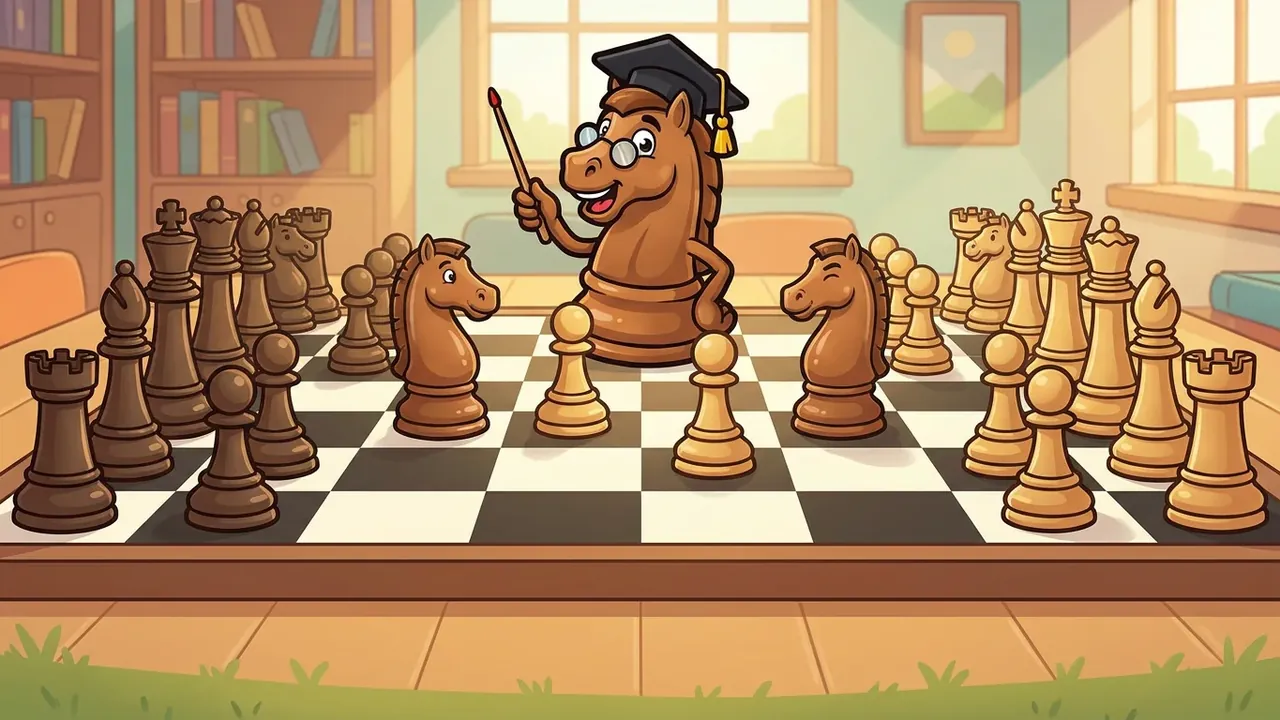
The best way is to play games and comment on them, not to memorize. The Chess Academy Kids app has a course with the knight professor that includes a block on how to start the game well, and you can play against the app with a coach that rates each move and explains why. That is exactly what is needed: someone, with patience, saying "that move leaves a piece undefended".
What is the best opening for a child who is starting?
There is no single best one, but the most recommended are those built on clear principles: e4 with classical development, the Italian Game, or d4 with a simple scheme. What matters is that the child understands why each move is played, not how many they know by heart.
Do you have to memorize openings?
No. At early ages it is better to understand three ideas (center, development and a safe king) than to memorize variations. Memory helps more later, once the ideas behind each move are understood.
What should a child play with Black?
The simplest is to answer the center with the center (e5 against e4, d5 against d4), bring out the knights and bishops, defend whatever is attacked and castle. Playing Black is not a big disadvantage: it is just one turn later.