Learn chess
Castling explained for kids: short, long and when you can't
What castling is in chess, how to castle short and long, the four conditions you need and the things that stop it, with before-and-after diagrams for kids.
Castling is the oddest move in chess, because it is the only one where two pieces move at once. It is also one of the most useful: it puts the king in safety and brings the rook into the game in a single move. To many kids it feels like magic and to others like a muddle. In this guide we take it apart with diagrams, for children aged 6 to 10 and for those who teach them. If you are not yet sure how the king and the rook move, review how chess pieces move first.
The essentials in one minute
- The king and one rook move in the same turn. It counts as a single move.
- The king moves two squares towards the rook, and the rook jumps over and lands right on the other side of the king.
- There are two kinds: short (with the rook on the king's side) and long (with the rook on the queen's side).
- Four conditions must be met; if one fails, you cannot castle at that moment.
- Important: you start by moving the king (two squares) and then the rook. That is how the rule is set out.
What castling is: the safety move
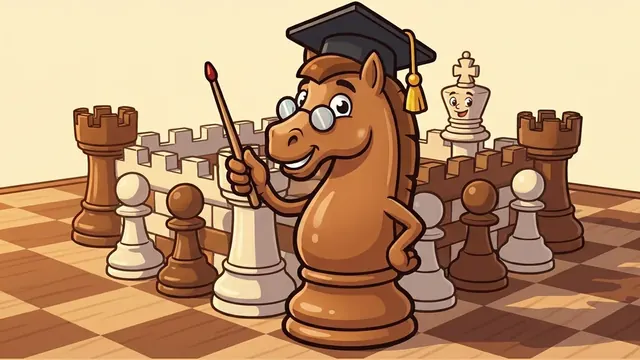
At the start of the game, the king stands in the centre, surrounded by danger. Castling takes him to a corner, behind his pawns, and the rook leaves its corner and starts to play. It is like moving the king to another room and putting a guard at the door.
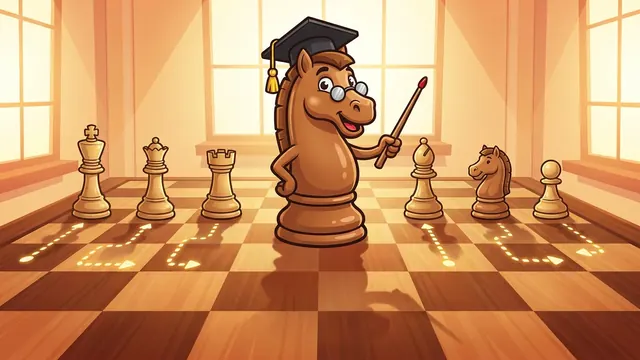
This is the starting position for castling, with only kings and rooks so you can see it clearly. The arrows show what happens in each kind.
Short castling
Short castling uses the rook in the king's corner (h1 for White, h8 for Black). The king jumps from e1 to g1 (two squares to the right) and the rook goes from h1 to f1, right on the other side of the king. It is called "short" because the rook only crosses two squares.
Long castling
Long castling uses the rook on the other side, the one on a1. The king moves from e1 to c1 (two squares to the left) and the rook goes from a1 to d1. It is called "long" because the rook travels three squares.
Black does the same on its own row: the king from e8 to g8 (short) or to c8 (long), and the rook to the other side.
Typical kids' mistake: moving the rook first and then the king, or moving the king three squares. In the official rule, castling is made by moving the king two squares and then the rook to the other side. If in a tournament game you move only the rook, that is not castling: it is a rook move, and you will no longer be able to castle on that side.
Memory trick: "king two steps, rook to the other side." And to tell short from long: in short castling the rook comes from the corner near the king, and in long castling from the far corner. The closer, the shorter.
Mini exercise: put only the king and rooks on the board and practise short and long castling ten times each. Have the child count out loud: "one, two (king), and the rook jumps."
The four conditions: when you CAN castle
To castle you need all four, and it helps to turn them into a checklist:
- The king has never moved in the game (not once, even if he came back to his square).
- The rook you castle with has never moved either. If you have already moved the rook from h1, you lost short castling, even if the king is still home. Long castling is still available if the other rook has not moved.
- There is no piece between the king and the rook. Neither yours nor the enemy's. You must have moved the knight and bishop out of the way first.
- The king is not in check, does not pass through an attacked square and does not land on an attacked square. That is: he does not start, cross or end on a square an enemy attacks.
What is allowed, and many people think it is not: the rook may be attacked, or the rook may pass over an attacked square (in long castling, the b1 square may be attacked). And you can castle even if the king has been in check earlier, as long as he did not move. All that matters is the king's state at the moment of castling and the squares he crosses.
The things that stop it
Let us look at three diagrams in which White would like to castle short and cannot.
There is a piece in the way. While the knight is still on g1, the king cannot pass.
The king is in check. Here the black rook on e4 attacks the white king. With the king in check you cannot castle. You have to get out of check first.
The king would pass through an attacked square. Here the king is not in check, but the black rook on f8 watches the f1 square, exactly where the king would pass. That is not allowed either.
Notice the last case: it is the hardest for kids to see, because the king "is not even in danger." The rule sits in the path, not at the starting point. Each time you want to castle, go through it out loud: have I moved the king? have I moved that rook? is anything in between? is any of the king's three squares (where he is, where he crosses and where he lands) attacked?
Typical mistake: thinking you cannot castle if the rook is attacked. You can. Another mistake: castling with Black and writing the square wrongly, putting the king in the wrong place.
Memory trick: the four-condition sentence, "neither king nor rook has moved, a clear path and no checks along the way."
Mini exercise: set up the starting position, play four or five free moves to bring out the knight and bishop, and find the exact moment you can castle. Then repeat with an enemy rook attacking one of the squares on the way.
When castling is a good idea
Almost always early. A simple rule for the first steps: bring out knights and bishops, and castle before launching attacks. A king left in the centre with an open column is an easy target, and if you spot it in time, castling puts him in safety. More on this idea in the article on king safety.
A note: short castling is usually kids' favourite, because the king ends up closer to the corner and you need to move fewer pieces first. Long castling puts the rook to work better, but you have to clear three squares (knight, bishop and queen).
Practising it with help
To make castling stick, nothing beats playing it. In Chess Academy Kids you can play against the app with a coach that rates every move and explains why, and the course with the knight professor builds these ideas step by step, from how each piece moves. If you are the one who does not know chess and wants to teach, start with this guide for parents. And to round out the special rules, see en passant and pawn promotion.
Can you castle if the rook is attacked?
Yes. The rule only requires that the king is not in check and does not pass through or land on an attacked square. The rook may be attacked, and in long castling even the square that only the rook crosses (b1 or b8) may be attacked.
Can you castle after having been in check?
Yes, as long as the king has not moved. A check in the past does not matter: what counts is that the king is not in check at the moment of castling and does not cross attacked squares.
How many times can you castle in a game?
Only once per player, because after castling the king has already moved. And if you lose the right on one side (for example by moving a rook), you can keep the other side's.