Learn chess
King safety in chess: how to keep your king safe from the start
Why a king in the center is dangerous, how to castle and keep a pawn shield, and how to teach king safety to a child aged 6 to 11 with examples and exercises.
King safety means putting the king where it is hard to attack, usually in a corner with pawns in front. The king cannot be captured, but if it is checkmated the game is over, so looking after it comes first.
Key points
- The king starts in the center, the worst place for it once the lines open up.
- Castling makes it safe and brings a rook into play, in a single move.
- The pawns in front of the king (f, g and h) form a shield: do not move them without a reason.
- An open file near the king is a motorway for the opponent's rooks and queen.
- In the endgame, with few pieces left, the king steps out to play: there is much less danger.
What king safety is, in one sentence
It is leaving the king in a corner protected by its pawns and its pieces, so the opponent has no easy road to it.
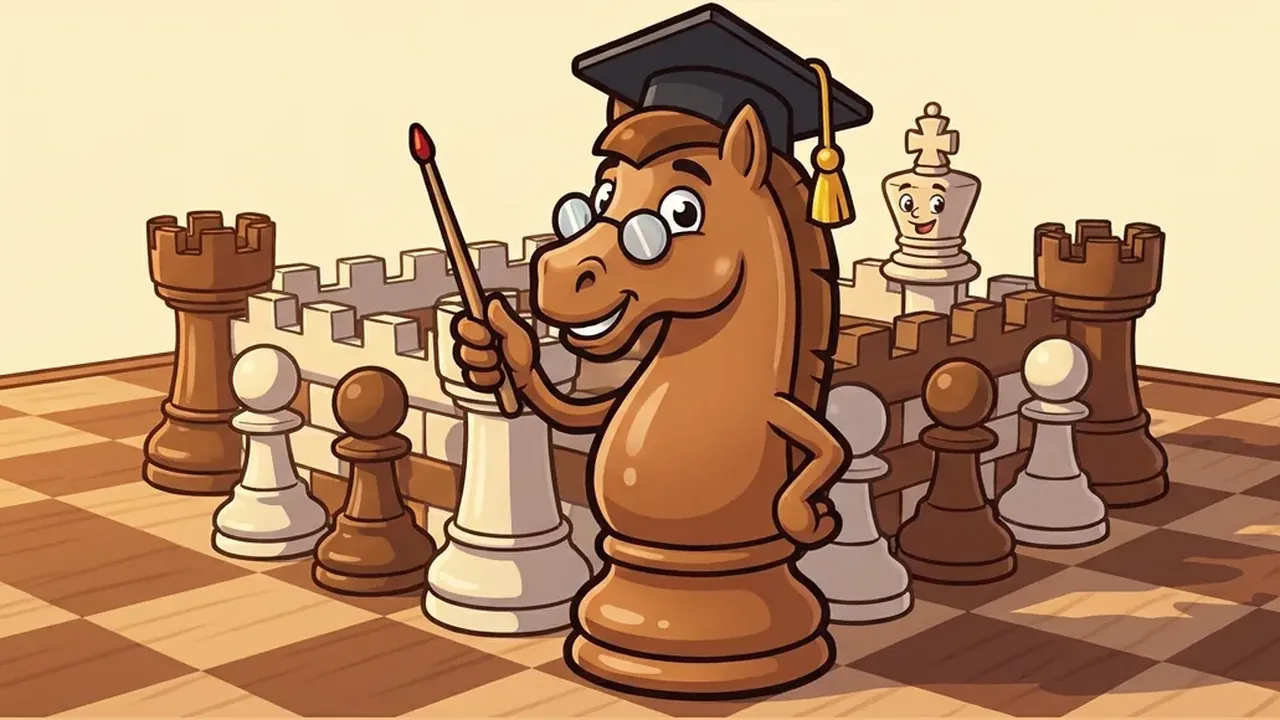
The idea of a castle works well with a child: the king lives in the tower, the pawns are the wall, and the rooks and bishops are the soldiers on guard.
Both kings in this diagram have castled. Behind their three pawns, they have few squares where an attack can reach them. This is the picture we want before about move ten.
Why the king in the center is dangerous
At the start, with the center full of pawns, the king is calm. But when pawns start to be traded and files and diagonals open, a king still on e1 or e8 is in view of all the opponent's pieces.
Here is a classic example, the Légal trap. White seems to give away the queen, and Black takes it with the bishop. But the black king is still in the center, and White traps it with a very quick mate.
The sequence is: the bishop from c4 captures on f7 with check, the black king can only go to e7, and the knight from c3 jumps to d5 giving checkmate. Notice that the black pawns and pieces block the king's exits: nobody can help it because it is stuck in the middle of everything.
The lesson: a king that has not been made safe has no help exactly when it needs it most. You do not need to memorize this trap; it is enough to understand why it works.
How to make the king safe
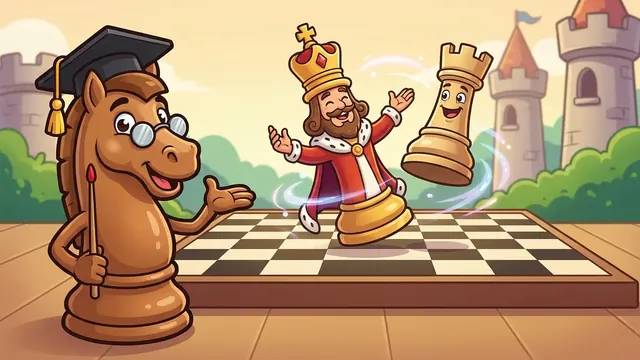
The simplest method is castling. It happens in a single move: the king moves two squares toward a rook, and the rook jumps to the other side. It is explained in castling explained for kids.
But castling is not enough if the shield is broken afterward. To keep the king safe:
- Do not move the f, g and h pawns without a clear reason. Every advanced pawn leaves unwatched squares near the king.
- Do not leave an open file in front of your king without a rook or the queen watching it.
- Keep a piece (for example, a knight on f3) near the king, defending the weak squares.
- Give it an escape square if needed. In chess that is called "making luft", and you will find it in back rank mate.
There is also an important rules detail. There are moments when you cannot castle, for example if the king is in check, if it has already moved, or if it passes over a square that the opponent watches. We see it in exercise 3.
The typical mistake
- Never castling. The child starts attacking with the queen and the king stays on e1 with nobody watching it. Many games are lost because of a forgotten king.
- Castling and then moving the shield pawns. It is like opening a window in the wall.
- Running around with the king in mid-game. Even if it sounds like a good idea, a king in the center without protection usually ends badly.
- Thinking the king does not matter because it "only moves one square". It moves little, but it is the most important piece.
How to spot it in a game: the magic question
Before each move, ask yourself: can my king be checked or threatened with mate by the opponent's next move?
If the answer is "yes" or "I don't know", look before you move. It is the same question that helps with playing without rushing: stop for a moment to look at the opponent.
How to defend when your king is attacked
- Trade the attacking pieces. With fewer pieces against your king, the danger drops.
- Cover the weak squares with your own pieces, for example with a knight.
- Make luft (move a shield pawn one square) only if necessary, so the king is not left in a corridor.
- Counterattack in the center. Sometimes the best defense is to open another area, but only if the king is not in immediate danger.
- Always look at checks first. Before choosing your answer, go over all the checks the opponent can give.
A trick to remember it
"Knight, bishop, castle. Then we'll see." If the king has castled within the first ten moves, you are doing fine.
Another trick for kids: draw three pawns in front of the king and say out loud "my wall": if there is a gap, it is time to think whether it needs plugging.
Exercises to do at home
Exercise 1: castle
It is your turn as White. You have already brought out both knights and the bishop on c4, and your king is still on e1 with the rook on h1. Which move makes the king safe?
Solution: short castling: the king goes from e1 to g1 and the rook from h1 to f1. Black has already castled.
Exercise 2: what does Black do?
The black king is still on e8, with the rook on h8. White is already castled. It is Black's turn.
Solution: short castling (king to g8, rook to f8). It is the same idea White used: king safe, rook in play.
Exercise 3: can you castle?
White wants to castle short, but the black bishop on c4 looks at f1.
Solution: castling is not allowed. The king cannot cross a square watched by the opponent, and the bishop watches f1. A simple way out is to move the king to f2, which is not watched. Castling rules: the king cannot be in check, cannot pass over or land on an attacked square, and cannot have moved before.
Where to practice it
The app's course with the knight professor teaches check, checkmate and how to start well, which includes putting the king safe: chess course with the knight professor. To see how a king behaves in real games, you can play against the app with a coach that rates every move: play against the app with a coach.
And to practice the other side, mates against a king with no escape, see check and checkmate for kids and developing pieces in the opening.
Do you always have to castle?
Not always, but almost always at the start. If there is a concrete reason not to castle, that is fine, but make sure it is a reason and not an oversight. As a rule for kids, castle before move ten.
Is short or long castling better?
To begin with, short: it is simpler because there are fewer pieces between the king and the rook. Long castling exists and is used, but it leaves the king a little further from its friends and is better learned later.
When is the king no longer in danger?
When few pieces are left on the board, especially without queens, the king is far less exposed and becomes an attacking piece. It is in the endgame that it is worth bringing it to the center.