Learn chess
Back rank mate: how to play it and how to avoid it in chess
What back rank mate is, how it is played with a rook or queen, how to avoid it by making luft for the king and how to set it up with a sacrifice. For kids.
Back rank mate is a checkmate on the king's home rank (its first rank) in which it cannot escape because its own pawns block the squares in front of it. A rook or a queen gives check along the rank and the king is trapped in the "corridor".
Key points
- The king is on its first rank, with the three pawns in front of it unmoved (f, g and h, usually after castling).
- A rook or a queen reaches that rank and gives check. The king has nowhere to go.
- To avoid it, you make luft: you move a pawn (h3, for example) to give an escape square.
- To play it, you have to reach the rank with a rook or a queen, sometimes after removing the defender.
- It is one of the first mates that appear in children's games, and it is learned in the course.
What back rank mate is, in one sentence
It is a mate in which the king, locked in on its first rank by its own pawns, receives a check from a rook or queen that it cannot escape.
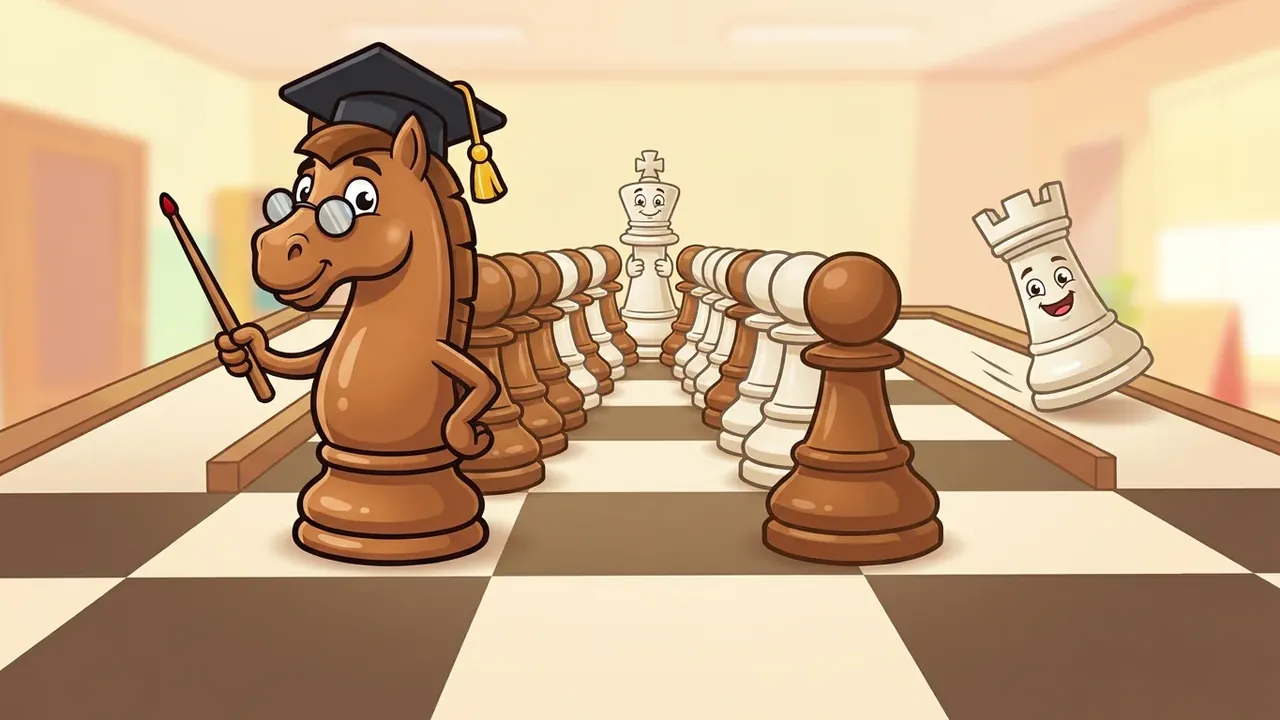
Imagine a corridor with a door at the end: if a monster comes in at one end and the king has no windows, there is no way out. The pawns in front are the walls, and nobody has made them a window.
Example 1: the mate with a rook
Black has castled and has its three pawns unmoved. White has a rook on the a file, which is open.
The rook goes up to a8 and gives check along the eighth rank. The king cannot go to f8 or h8 (the rook watches them), nor to f7, g7 or h7 (its own pawns are there), and no piece can capture the rook or block the check. Checkmate.
Example 2: the mate with a queen
It works exactly the same way with the queen.
The queen from e1 goes up to e8, gives check along the rank, and the king on g8 cannot capture it (it is two squares away) or escape anywhere. Checkmate.
How to avoid it: make luft for the king
The solution is to give the king a square to go to. A single pawn move is enough.
Here the pawn on h7 has advanced to h6, and the king on g8 can escape to h7. The rook gives check on a8, but the king plays to h7 and nothing happens. That escape square is called "luft" (German for "air"), which is why we say "make luft" or "give the king air".
The best time to do it is before it is needed. If you do it when an enemy rook is already on your rank, it may be too late.
How to set it up: remove the defender
Sometimes the opponent has a rook defending the back rank, and the solution is to eliminate it. There is a classic trick: sacrificing the queen to remove the defending rook.
The white queen goes to d8 with check. The only way to save the king is to capture it with the rook from c8 (there is no other way out). But then the black rook has ended up on d8, right on the file of the white rook on d1, which captures it with checkmate: the king still has no escape squares.
This kind of move is called a sacrifice: you give up material to win something bigger, here the mate. It is one of the first things you can show a child about how an attack is thought out.
The typical mistake
- Castling and leaving the three pawns unmoved all game, with no rook of your own on the first rank and no escape square.
- Moving the rooks far from the first rank and leaving the king with no defender on the rank.
- Not checking whether the opponent has an open file to reach your first rank.
- Not looking at the opponent's corridor. Many kids defend their own well and do not see that the enemy king is also locked in.
- Making a capture that looks free without checking whether it leaves the first rank open.
How to spot it in a game: the magic question
There are two questions, one for you and one for the opponent:
- To defend: if an enemy rook reached my first rank, would my king have an escape square?
- To attack: does the enemy king have an escape square on its first rank? If not, can I get there with a rook or a queen?
It is a question of seconds, and it avoids many mates. If your child moves very fast, this question is a good brake: my child plays too fast without thinking.
How to defend
- Make luft in time. One pawn (h3 or g3, for example) and the king has a square. If you play h3, your king has luft on h2.
- Keep a rook on the first rank. With a rook defending, it is very hard to be mated.
- Cover the entry square. If the opponent has an open file, put a piece that controls the square where their rook would arrive.
- Trade the attacking rook. If two enemy rooks fight for the file, trading them reduces the danger.
A trick to remember it
"Give your king some air." When you have a quiet moment, move one pawn in front of the king one square. A king without air gets smothered.
Another: "castled king, look at the rank." After castling, ask yourself: can my king escape?
Exercises to do at home
Exercise 1: now Black plays
It is your turn as Black. The white king is locked in behind its three pawns. Which rook goes to which square to give mate?
Solution: the rook from d8 goes down to d1. It gives check along the first rank and the white king cannot go anywhere: f1 and h1 are watched by the rook, and f2, g2 and h2 are taken by its own pawns.
Exercise 2: avoid the mate
Same position, but now White plays. Black threatens Rook to d1 with checkmate. Which pawn move avoids the mate?
Solution: h3. Now, if the black rook gives check on d1, the king escapes to h2. g3 or f3 would also work, freeing g2 or f2. What matters is to give the king luft before it is too late.
Exercise 3: the queen sacrifice
White to move. The black rook on c8 defends the first rank. How do you remove it?
Solution: Queen to e8 with check. The black rook has to capture it, and then the rook from e1 captures on e8 and it is mate: the king on g8 still has no escape.
Where to practice it
The app's course with the knight professor has a check and checkmate block, where back rank mate appears: chess course with the knight professor. There are also tactics puzzles with a hint and a solution: chess puzzles for kids: tactics. And to see how it is played in real games, you can play against the app with a coach.
To carry on, see check and checkmate for kids, king safety in chess and double attack in chess.
Why is it called back rank mate?
Because the king is locked in on its first rank, like in a narrow corridor, with its own pawns in front. The attacking piece enters along the rank and the king has nowhere to run.
What does making luft for the king mean?
It means moving a pawn in front of the king (for example h3 or g3) so the king has an escape square on its first rank. With it, back rank mate no longer works.
Which pieces can give back rank mate?
A rook or a queen, which give check along a rank. The bishop and the knight cannot deliver this mate, because they do not attack in a straight line along the rank.