Learn chess
Pawn structure for kids: doubled, isolated and passed pawns
What pawn structure is, what doubled, isolated, backward, chain and passed pawns are, and what to avoid. With diagrams and exercises for kids aged 6 to 11.
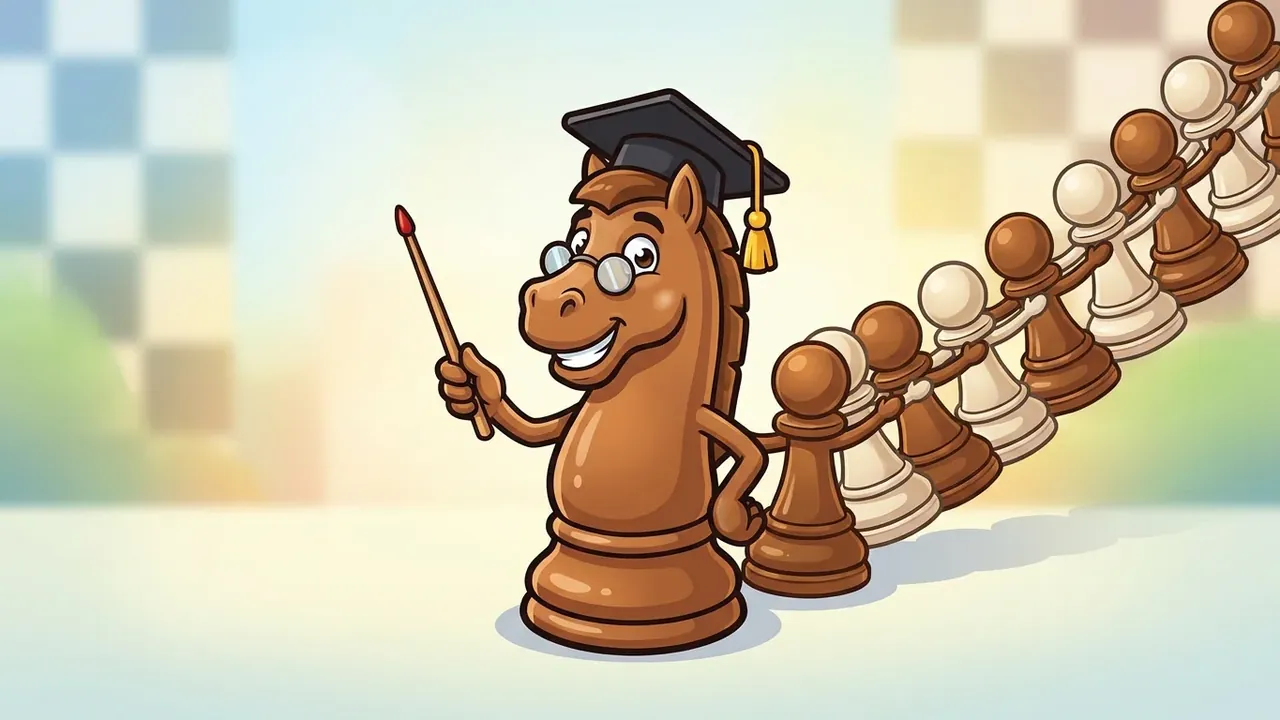
Pawn structure is the shape the pawns draw on the board. Pawns cannot move backward, so every time you move one you decide what that shape will be for a long time. A good structure gives you strength; a bad one leaves weak points the opponent can use.
Key points
- Pawns never go back: every move is forever.
- Pawns protect each other better than any other piece does, if they are close together.
- Try to avoid doubled, isolated and backward pawns when you can.
- A pawn chain is very solid, but it has one weak point: the base.
- A passed pawn is a pawn that no enemy pawn can stop: it is a queen candidate.
What pawn structure is, in one sentence
It is the pattern formed by the pawns of both sides, which decides which squares are strong, which are weak and where the pieces can go.
For a child: pawns are the bricks of the house. The pieces live inside, but if the bricks are badly placed, the house leaks.
The five types you need to know
1. Doubled pawns
These are two pawns of the same color on the same file, one behind the other. They get in each other's way and cannot protect each other.
They usually appear when one piece captures another and a pawn recaptures sideways. The problem is that the rear pawn cannot help the front one, and together they control fewer squares than they would on different files.
2. Isolated pawn
This is a pawn with no friendly pawns on the files next to it. No pawn can protect it.
The square in front of it (d5, here) is a comfortable place for an enemy piece to settle, because no pawn can chase it away. And to defend the pawn you have to use pieces, which then cannot do other jobs.
3. Backward pawn
This is a pawn that has been left behind its neighbors and cannot advance without being captured.
The pawn on d3 has been left behind, and the square in front (d4) is watched by Black's pawns. That square becomes a hole where an enemy piece can settle. On top of that, the d file is half open for Black's rooks, which aim straight at the pawn.
4. Pawn chain
These are pawns on a diagonal protecting each other. Each pawn protects the next.
It is a solid structure: to win a pawn from the chain, the opponent must attack the pawn at the base (c3 in this diagram), because it is the only one no other pawn protects. That is why the saying goes: "attack the base of the chain".
5. Passed pawn
This is a pawn with no enemy pawns in front of it or on the files next to it. No enemy pawn can stop it, only pieces.
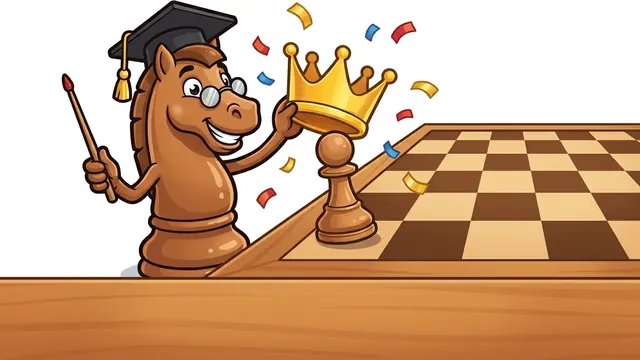
A passed pawn is a permanent threat, because the opponent always has to keep an eye on it. If it reaches the last rank, it becomes a queen (pawn promotion explained).
What to avoid and why
Almost nothing in chess is absolute, but these three common-sense rules help a child a lot:
- Avoid capturing with a pawn if that leaves you with doubled pawns, unless you win something clear in return.
- Avoid leaving a pawn alone. When you move a side pawn, ask whether its neighbors can still protect each other.
- Do not advance a pawn beyond its neighbors if it cannot protect itself afterward.
Careful not to overdo it: sometimes doubled pawns give rooks an open file, and an isolated pawn can be very active. But first you need to know the general rule; the exceptions are learned with experience.
The typical mistake
The most common beginner mistake with pawns is moving the pawn that "doesn't matter". A child moves an edge pawn, or the one next to the king, or captures with a pawn without looking at the structure that is left. Later, the structure haunts them all game.
The second mistake is not looking at the opponent's structure. An enemy isolated or backward pawn is a target: you attack it with pieces.
How to spot it in a game: the magic question
Before moving a pawn or capturing with one, ask: who is each of my pawns left with after this move, is it accompanied or alone?
If it is left alone, or with another pawn right in front of it, see whether there is a better way to make the move.
How to defend
- If you end up with a doubled pawn, look for compensation: an open file for the rooks, the pair of bishops, or an attack on some point of the opponent's position.
- If you have an isolated pawn, protect it with pieces and do not let an enemy piece settle in front of it.
- If you have a backward pawn, try to trade the pieces attacking it or advance another pawn to help it.
- If the opponent has a passed pawn, try to block it with a piece (the knight is very good at that) and, if you can, trade it off before it advances.
A trick to remember it
"Pawns together, pawns strong." And the three-word game: doubled = two on the same file; isolated = no neighbors; passed = no enemies ahead.
Another trick for kids: imagine each pawn holding hands with the one next to it. A pawn with no hands to hold is alone; and if nobody ahead can stop it, it runs free!
Exercises to do at home
Exercise 1: find the isolated pawns
Look at the two structures. Which pawns are isolated, that is, have no friendly pawns on the files next to them?
Solution: the black pawn on a7 and the white pawn on d2. The one on a7 has no pawn on the b file, and the one on d2 has no pawns on c or e. The rest protect each other: a2 with b2, c7 with d5, and f, g and h among themselves.
Exercise 2: doubled?
White has just captured the knight on c6 with the bishop. How does the black pawn recapture and what structure is left?
Solution: the pawn from d7 captures on c6 and Black is left with two pawns on the c file (on c6 and c7): doubled pawns. It is not a disaster: Black has the pair of bishops and the open d file. But it is good to know that the doubled pawn is a point that can be attacked.
Exercise 3: which one is the passed pawn?
White has three pawns and Black has two. Which pawn is passed?
Solution: the white pawn on b5. There are no black pawns on the a, b or c files, so its road to the last rank is free of pawns. White's pawns on g2 and h2 are not passed because Black's pawns on f7 and g7 are ahead of them, on their file or on the next ones.
Where to practice it
The app's course with the knight professor has a "how to find the best move" block that teaches you to look at the board before you move, which includes looking after your pawns: chess course with the knight professor. And to try these ideas in real games, there is play against the app with a coach, which rates every move and explains why.
To carry on with strategy, see controlling the center in chess and, to understand where passed pawns lead, king and pawn endgame: opposition.
Is a doubled pawn always bad?
Not always. It is usually a weakness, but sometimes it is compensated by an open file for the rooks or by the pair of bishops. For kids, the useful rule is: avoid it unless you win something clear in return.
What is the difference between an isolated pawn and a backward pawn?
The isolated pawn has no friendly pawns on the files next to it. The backward pawn does have them, but it has been left behind them and cannot advance without being captured. Both are weaknesses, for different reasons.
At what age can I teach pawn structure?
Around 7 or 8 years old, when the child already knows the rules and plays complete games. With younger children, the idea that pawns together protect each other and lonely pawns get lost is enough.