Learn chess
King and pawn endgame: the square rule and opposition
King and pawn against king: the rule of the square, key squares, opposition and promotion. With checked theoretical positions and exercises to do at home.
Two kings and one pawn are left. It looks like the simplest thing in the world, and yet this is where more games are won and lost than you might imagine. A child who plays this ending well has a huge advantage: they know when it is worth trading the pieces, because they know the result of the ending that remains.
The good news is that nearly everything comes down to four ideas: the rule of the square, the help of the king, opposition and promotion. Let us take them one by one, with theoretical positions that we have checked.
Key points
- Rule of the square: if the defending king is inside the pawn's square (or can step into it when it is his move), he catches the pawn.
- A lone pawn does not promote if the enemy king arrives in time: it needs its own king.
- A king in front of the pawn, above all on the key squares, almost always wins.
- Opposition (the kings face to face with one square between them) decides many endings: whoever makes the other side move, wins the fight.
- When promoting, watch for stalemate: a queen can leave the opponent with no legal moves and turn a win into a draw.
The pieces and the notation here
We use K for king and Q for queen. The pawn has no letter. Squares are a letter and a number: e5, h8. The "defending king" is the one trying to stop the pawn; the "attacking king" is the one trying to help it promote.
Idea 1: the rule of the square
Suppose the white pawn is on e5 and the black king is far away, with the white king unable to help. Does the pawn promote or does the king catch it?
There is a visual trick that never fails: draw a square. The pawn on e5 needs 3 moves to reach e8 (e6, e7, e8). So the square has sides of 3 squares: from e5 to the right as far as h5, and up to e8 and h8. It is the square e5, h5, e8, h8.
If the black king fits inside the square when it is his move, he catches the pawn. If he is outside, the pawn promotes. (One detail: if the pawn is still on the second row, count it as if it were on the third, because it can advance two squares at once.)
Let us see it with White to move and their king far away, on a1. First, the black king on h5, inside the square.
After e6 Kg6, e7 Kf7, the pawn on e7 is attacked and the white king is too far away to defend it: the black king will capture it. A draw.
Now the same pawn, but with the black king one square outside the square, on h4.
e6 Kg5, e7 Kf6, e8=Q: the black king is one step late. The white queen is on the board.
The memory trick: if the king can step into the square, he catches the pawn; if he cannot, the pawn promotes. The exercise at home: place a pawn and a faraway enemy king, draw the square with your finger, and let your child decide before moving.
Idea 2: the king in front of the pawn and the key squares
The lone pawn only has the rule of the square. But if its king stands in front of it, everything changes. When the white king reaches certain squares in front of the pawn (they are called key squares), the pawn promotes even if the black king defends in the best possible way.
For a pawn on e5 (or on e4), three of those key squares are d6, e6 and f6, the three squares on the sixth row right in front of the pawn. A very clear example: white pawn on e5, white king on e6 and black king on e8. White wins, whoever is to move (we checked it with endgame tablebases).
The idea is to go around the black king: the white king steps aside (Kd6) and then pushes the pawn with the king next to it, protecting it. A king that goes in front of the pawn opens the way; a king that stays behind hardly helps. That is the big difference between a good and a bad pawn ending.
The trick: the king goes first, the pawn behind.
Idea 3: opposition
Now the difficult case. The pawn is on e4 and the white king on e5, right in front of it. The black king is on e7. The kings stand on the same file with one empty square between them: this is called opposition.
The key question: what happens if White moves, and what happens if Black moves? The answer is a classic of chess: whoever makes the opponent move, wins. With White to move, it is a draw.
With White to move, the black king can always step back in front of the white king and the pawn never advances safely: a draw. But if it is Black's turn, the black king has to give way. For example: ...Kd7, Kf6, and the white king is already on a key square (f6, on the sixth row).
From here the plan is simple: the white king advances with the pawn, always in front, and the black king cannot stop it. A few moves later the pawn promotes.
The memory trick: you "have" the opposition when the opponent has to move.
Idea 4: promote with your head
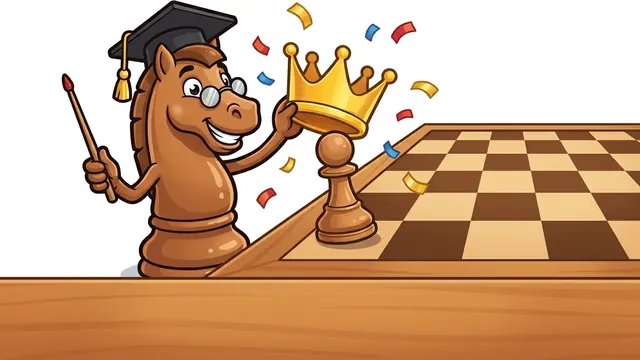
When the pawn reaches the last row, it becomes another piece. Almost always you choose the queen. But watch out for two things.
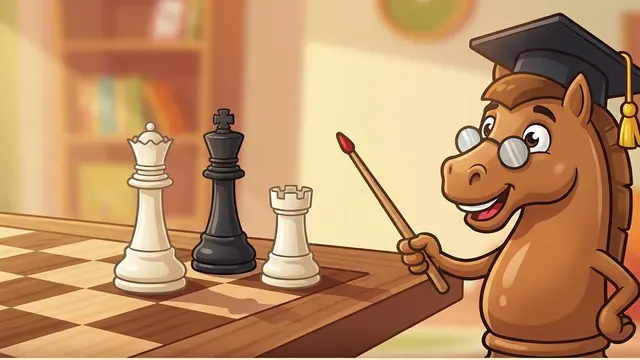
First, the queen can give mate straight away. Look at this ending: the pawn on c7 promotes on c8 and the black king, in the corner, cannot escape.
Second, stalemate: if the enemy king is in the corner and one of your moves leaves him with no squares and no check, the game is a draw. It is a typical trap when the pawn is on the h-file or the a-file, next to the corner.
With rook pawns (the a-file or the h-file), if the defending king reaches the promotion corner, it is a draw. That is why a rook pawn wins far less often than it seems: it is not bad luck, it is theory.
Typical mistakes
- Moving the pawn before the king. With the black king close, the lone pawn is usually lost. First the king in front.
- Not counting the square. Many children give up a won position or run into a lost one because they did not check whether the enemy king arrives.
- Forgetting whose turn it is. In opposition, whoever has to move loses ground.
- Promoting carelessly. Before putting the queen down, check whether the enemy king is left without moves.
To do at home
Play the "race": a pawn and two kings in each position of this article. One player takes the pawn and its king; the other, the defending king. Then swap roles. And as always with endgames, they are learned very well with an app that gives feedback move by move: with Chess Academy Kids you can play against the app with a coach that rates each move and tells you why, and the course with the knight professor builds the foundations.
If the pawn promotes and doubts remain about the queen or the rook, the previous article, queen and rook checkmates, closes the circle. It will also help to review pawn promotion and draws by stalemate.
What is opposition in chess?
It is when the two kings are on the same file, row or diagonal with just one empty square between them. Whoever has to move in that situation must give ground. In king and pawn endings, having the opposition often decides whether the pawn promotes.
How do you use the rule of the square?
You count the moves the pawn needs to promote and draw a square of that size starting from the pawn. If the enemy king is inside the square when it is his move, he catches the pawn; if not, the pawn promotes. It works when the pawn's own king cannot help.
Is it always a good idea to promote to a queen?
Almost always, because it is the strongest piece, but there are rare exceptions. What matters is to check first whether the enemy king is left with no squares and no check, because that would be stalemate and a draw instead of a win.