What worries parents
My child gets upset when losing at chess: what to do
Tears, an overturned board or "I'm never playing again" after a loss. How to help your child cope with defeat: an after-loss routine, your reaction and undo.
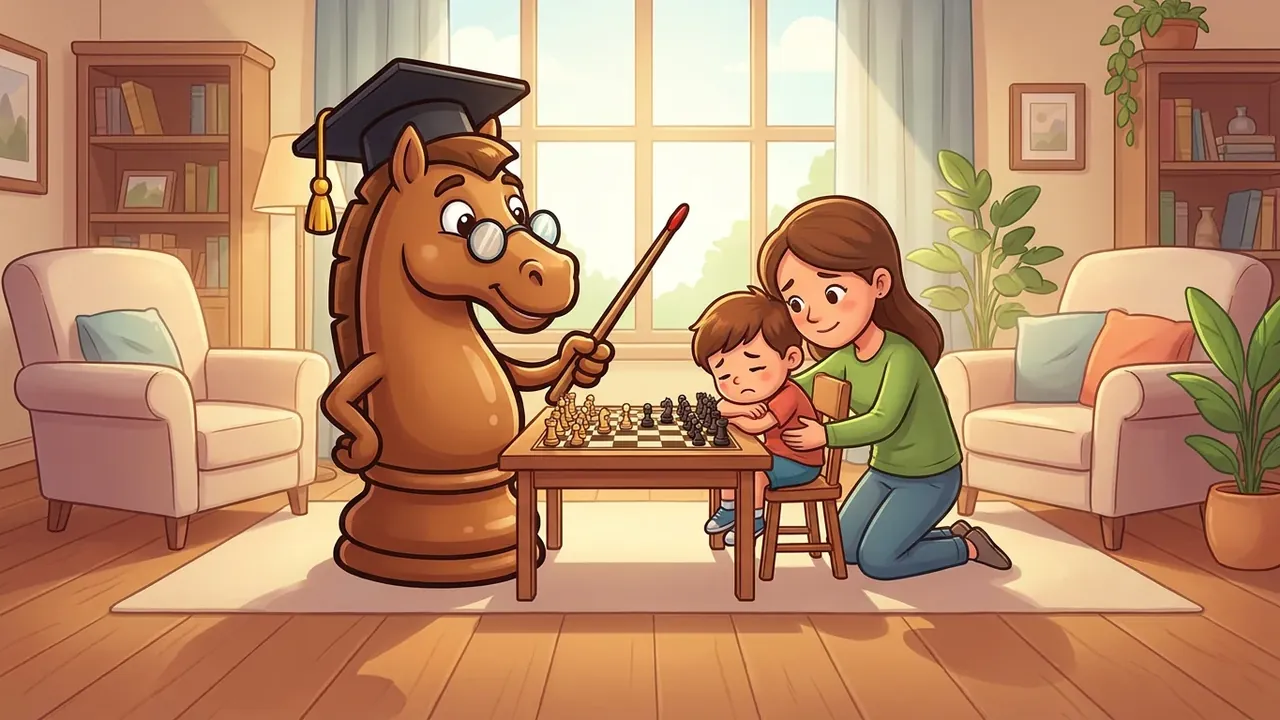
Imagine you are playing a game with your daughter. She is winning, moves her queen without looking and two moves later you capture it. Her face changes, she knocks the king over and says chess is silly and she is never playing again. You, with pieces all over the floor, wonder whether to comfort her, tell her off, or let her win so it stops. It probably sounds familiar.
A child hurting over a loss is not a bad sign. It means they care. What we can help them learn is what to do with that hurt.
Key points
- Crying or getting angry when losing is common in young children: they are still learning to regulate what they feel.
- Letting them win every time does not protect them: it takes away the chance to practise losing well.
- A fixed "after losing" routine (breathe, a gesture, one question) works better than a lecture in the heat of the moment.
- Your reaction counts: if you stay calm, they have a model.
- Evidence that chess improves tolerance of frustration is thin; what it does offer is plenty of safe occasions to practise it.
Why it hurts so much
In chess there is no luck to blame. If you lose, you lost because of a move you made. To a child of 5 or 6 that can feel unfair or humiliating, especially if they tried hard, if people were watching, or if a sibling beat them. And defeat arrives suddenly: a game can go very well for twenty moves and turn on one.
It usually gets better with age, but unevenly: your child may accept a defeat one day and fall apart the next because they were tired. It is not a straight line.
What is known (and what is not)
It is worth being honest: little is known about frustration and chess. A study in Tenerife of 170 schoolchildren aged 6 to 16 who played after-school chess, compared with 60 who played football or basketball, found improvements in coping and socio-emotional development. But the children were not assigned at random (those who pick chess may differ from the start), the tutor reports were not blind, and the authors themselves note that results depended on the pupil's profile. So we cannot claim that chess "teaches you to lose".
What is reasonable to say is that chess gives many small chances to practise: waiting for a turn, accepting a bad move, starting another game. And in the English trial with 4,009 pupils, half said they liked the lessons a lot and only 8% said they did not. Enjoying it helps children keep trying.
Your reaction counts more than you think
You are the first mirror. Some guidelines:
- Do not laugh or turn it into a joke when they cry, even if the knocked-over king amused you.
- Do not let them win every time. If you do, the day they lose to another child will be worse. A good mix: play for real, but with an edge for them (for example, remove one of your pieces) and shrink it over time.
- Validate first, teach after. "I can tell that made you really angry" before "look at what happened on move 12".
- Praise specific effort, not the result: "the way you defended your king" rather than "well done".
- Lose yourself now and then, and do it well. Say out loud: "Wow, you beat me, what a good move. I want another one." Your child learns more from seeing you lose with humour than from any talk.
A routine for after losing
A short routine that is always the same takes pressure off. Try this four-step version (two minutes):
- Breathe: three long breaths, blowing as if putting out a candle.
- Shake hands (or high-five) the opponent, even if it is the app or mum.
- One good thing and one to improve: "what did you do well? what would you change?" Only one of each.
- Decide: another game or a break? Let them choose, never in the heat of the moment.
If they are too upset, skip step 3 and come back once they have calmed down. Analysing a game through tears achieves nothing.
Undo, and a coach that explains without humiliating
Two tools help take away the fear of getting it wrong:
Undo. Being able to take a move back and try another turns a mistake into an experiment. Instead of "I did terribly", the child thinks "let me see what happens if I try this instead". In Chess Academy Kids you can undo to try the good move, as described in playing against the app with a coach.
A comment on the move, not on the child. "This move leaves the queen unprotected" is very different from "you were careless". The app's coach rates each move and explains why, always talking about the game. You can do the same: talk about the board, not about character.
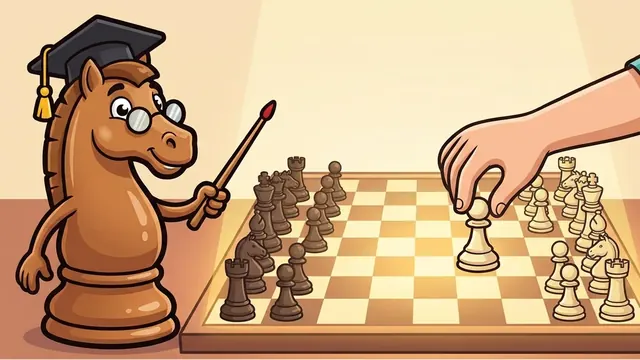
Look at this typical slip, the one that causes the most tears: the black queen is unprotected in front of the rook.
A trick to remember it: before moving, ask "is anything of mine left unprotected?" This avoids most beginner slips, and we practise it in how to teach chess at home.
What to do today
- Choose a calm moment (not right after a loss) and tell your child your four-step routine. Do it yourself with a different game, losing on purpose.
- Play a game with a small advantage for them, so they can win or lose by a narrow margin.
- If they lose, use the routine without lectures. One word of encouragement and on to something else.
- If they get very angry, stop the session, without punishment, and offer to pick it up tomorrow.
- Note whether the upset lasts less than last week. That is your indicator, not the result of the game.
If you need a patient opponent, in the Play mode the first level makes mistakes your child can take advantage of, and the puzzles with hints give small wins with no human opponent. With the progress report for parents you can look together at what is improving, not just what is lost.
When to ask for help
If the frustration is out of proportion in many situations (games, homework, meals), lasts a long time and worries you, talk to your paediatrician or a child psychologist. Chess is not therapy. It is a game, and the best it can be is a good place to rehearse.
What to avoid
- Labelling phrases: "you are a bad loser" sticks. Describe the behaviour ("we do not throw the pieces") and leave the person out of it.
- Prizes for winning: if you only celebrate victories, your child learns that losing is failure. Also celebrate a good defence, a brave idea or having kept playing after a bad moment.
- Long games when they are tired: late in the day or when hungry, frustration soars. It is better to play mid-afternoon and stop before tiredness shows.
- An immediate rematch when they are very upset: another game with the anger still inside usually ends worse. A glass of water and five minutes of something else help.
And remember that every child has their own pace: some lose with a smile at 5 and some still get angry at 9. Comparing them with a sibling or a friend does not help; comparing them with themselves a month ago does.
In short
Losing hurts because it matters. Your role is not to spare your child defeat but to accompany it: a fixed routine, a calm reaction from you, being able to undo and try again, and comments about the move and never about them. Science does not show that chess teaches tolerance of frustration, but it does offer many small games to rehearse in. With patience, the next time the king falls, perhaps they will pick it up themselves.
Should I let my child win so they don't get upset?
Not always. Letting them win every time removes the chance to practise losing, and the day they lose to another child will be harder. It is better to play for real with a small edge for them and reduce it over time.
Is it normal for my 5-year-old to cry when losing?
Yes, it is common: at that age children are still learning to manage strong emotions. A short after-loss routine and a calm reaction from you help. If it worries you a lot, talk to your paediatrician.
Does chess teach tolerance of frustration?
There is no solid proof. A study in Tenerife found socio-emotional improvements, but it was not randomised and the children chose the activity. What chess does offer is many small chances to accept a mistake and start another game.
Sources
- Aciego, R., García, L. and Betancort, M. (2012). The benefits of chess for the intellectual and social-emotional enrichment in schoolchildren. The Spanish Journal of Psychology. https://doi.org/10.5209/rev_sjop.2012.v15.n2.38866 (accessed 2026-10-26).
- Jerrim, J. et al. (2016). Chess in Schools: Evaluation report and executive summary. Education Endowment Foundation. https://files.eric.ed.gov/fulltext/ED581100.pdf (accessed 2026-10-26).