What worries parents
My child can't focus: what chess can (and can't) do
What is normal for a child's attention, what chess can offer and what it can't, and how to practise focus at home with short 10-minute games.
Picture a Saturday afternoon. You have set up the board with real enthusiasm, your child sits down, moves a pawn, looks out of the window, gets up for water, comes back, touches a piece and asks if they can have the tablet now. Six minutes have gone by. It probably sounds familiar, and you have probably wondered whether the problem is chess, your child, or your expectations.
Take a breath: it is usually the expectations. There are still ways to practise attention through chess, as long as you do not expect miracles.
Key points
- Young children find it hard to hold their attention on something that does not hook them. That is normal, not a flaw.
- There is no official number of minutes per age. The practical way is to measure how long your child sticks with something they love and start just below that.
- Chess can be a good place to practise attention, but science does not show that it improves concentration in general.
- If you suspect ADHD, chess is not a treatment: talk to your paediatrician or a professional.
- Short games, one goal per game and breaks beat long sessions.
What is normal at each age
Nobody has set an exact rule such as "at age 5, five minutes". What you see at home is this: a child aged 4 to 6 will stay far longer with a favourite show or a set of blocks than on a task an adult has set. Attention depends on age, but also on interest, sleep, hunger and whether the day at school was a long one.
So instead of trusting a chart, do your own measuring. For a week, notice how long your child plays in a row at something they like without asking you for anything. If it is 12 minutes with blocks, 10 minutes of chess is a good first target; if it is 5, start with 5. This is practical advice, not a finding from a study: the idea is simply not to ask for more than they already do naturally.
If your child is 4 or 5, see also what age to start chess: at that age very short, play-like sessions are the sensible choice.
What chess can offer attention
There are reasons to think chess helps you practise sustained attention: while you play you have to look at the whole board, remember what the opponent just moved and think before you move. It is an exercise in calm looking that many children enjoy.
What research says is more modest:
- In a large randomised trial in England (4,009 pupils aged 9 and 10 in 100 schools), teachers perceived improvements in learning skills such as concentration. That was a perception, not a measurement with an instrument. The same study found no effect on maths, reading or science a year later.
- The memory built by expert players seems to be mostly about chess itself: remembering board positions, not remembering anything better.
- The most careful reviews conclude that benefits in other areas are small or do not hold up once there are good control groups.
In short: chess is a pleasant place to practise paying attention, but there is no solid proof that this attention carries over to homework or class. If someone promises it, be wary.
And if you suspect something more: ADHD
Here it is worth being very clear: chess does not treat ADHD. There is a pilot study with 44 children aged 6 to 17 with ADHD in which, after 11 weeks of chess, parents scored improvements on attention and hyperactivity scales. But it was an open study with no control group, and the measures came from parents who knew their child was in the programme, so the effect of chess cannot be separated from expectation. Its own authors call for controlled studies.
If your child's attention worries you for real (at home and at school, for months, with distress), the useful step is to talk to your paediatrician or a health or educational psychology professional. Chess can be a pleasant activity alongside that, never instead of it.
How to practise attention with short games
The key is that your child finishes wanting more, not worn out. Some ideas:
- Mini-games with few pieces. A king and rook against a king, or one-move checkmate puzzles, end in a couple of minutes and give a clear finish.
- One goal per game. Today: "leave no piece unprotected". Tomorrow: "look for a check before moving". One goal is easier to hold than a thousand rules.
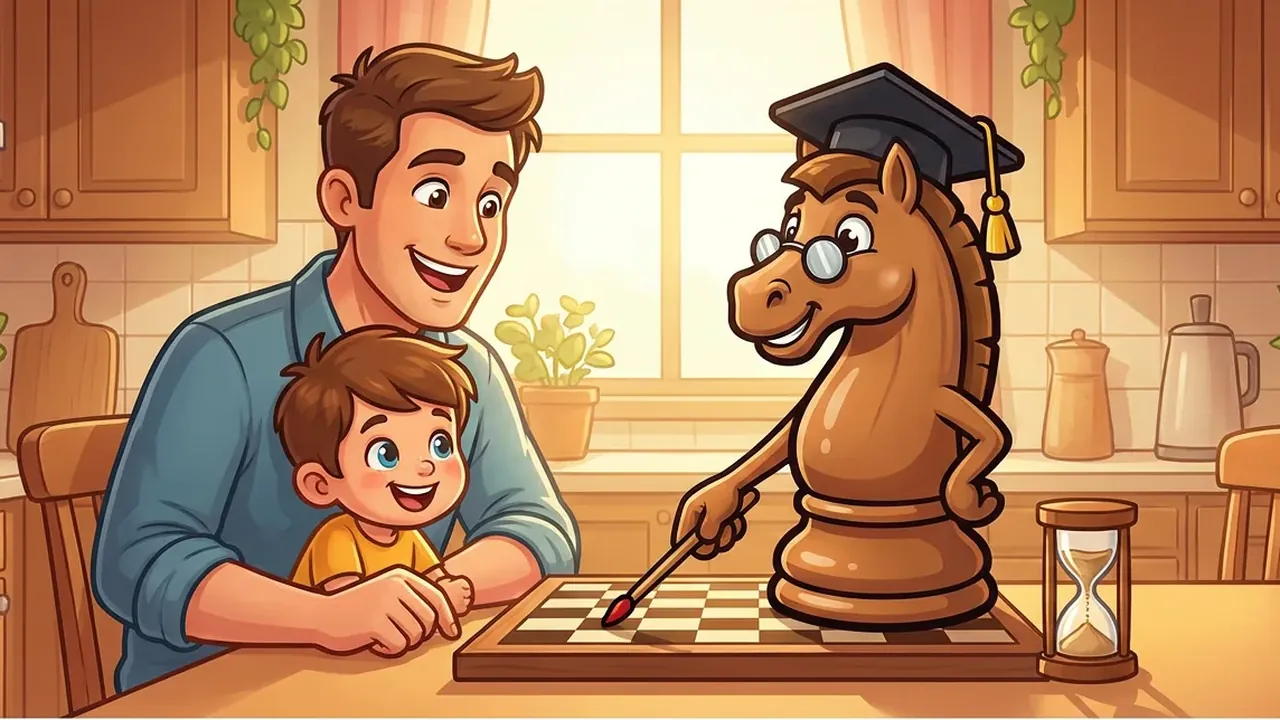
- A sand timer or visual timer. Let your child see how much is left. Ten minutes with an end in sight weigh less than "until we finish".
- An agreed break. Halfway, a minute for water and stretching. Come back to the game, not to a screen.
- Finish on a good note. Stop when things are going well, not when they are fed up.
A short example exercise: find the checkmate in one move. It is very brief, has one clear solution and makes your child look at the whole board before deciding.
This pattern is called the back rank mate and we explain it in back rank mate. To understand what a checkmate is, see check and checkmate for kids.
What to do today
- Measure how long your child plays in a row at something they like (today, without telling them).
- Pick a session of that length minus a couple of minutes. Put the timer where they can see it.
- Prepare one checkmate-in-one puzzle and one mini-game with few pieces.
- If you sit with them, do not correct every move: choose one thing to mention at the end.
- Finish before they get tired, and note (mentally) how many minutes they lasted. Tomorrow, the same time; next week, one minute more, no rush.
If you would rather have your child practise with some help, in Chess Academy Kids the chess puzzles for kids are short and come with hints, and playing against the app with a coach allows short games with comments on each move. With the progress report for parents you can see how things are going without hovering.
What not to do
- Do not use chess as a punishment or a reward for "if you behave".
- Do not compare with siblings or classmates.
- Do not stretch the session "since we are here". Next time they will not want to sit down.
- Do not expect school to improve: if it does, great; if not, chess will still have been a pleasant time together. More on what is known in benefits of chess for kids.
In short
A child's attention depends on their age, their day and what interests them; there is no magic number, only yours, measured at home. Chess is a pleasant ground for practising calm looking, with short sessions, one goal at a time and an ending with a good taste. There is no proof that it replaces anything or raises grades, and with a serious doubt about attention, the road is a professional, not a board.
At what age can a child focus on a whole game?
There is no fixed age. Many children aged 4 to 6 can last a few minutes at something they love, and a short game or a brief puzzle is more realistic than a full game. Start with the time they already give to a game they are excited about.
Does chess improve concentration at school?
It has not been shown. In a trial with more than 4,000 pupils teachers perceived better concentration, but that was a perception and there was no effect on maths, reading or science results. It is an activity that exercises attention inside the game itself.
Does chess help with ADHD?
Chess does not treat ADHD. There is a small pilot study with no control group whose authors ask for confirmation. If your child's attention worries you, talk to their paediatrician or a professional.
Sources
- Jerrim, J. et al. (2016). Chess in Schools: Evaluation report and executive summary. Education Endowment Foundation. https://files.eric.ed.gov/fulltext/ED581100.pdf (accessed 2026-10-26).
- Blasco-Fontecilla, H. et al. (2016). Efficacy of chess training for the treatment of ADHD: a prospective, open label study. Revista de Psiquiatría y Salud Mental. https://doi.org/10.1016/j.rpsm.2015.02.003 (accessed 2026-10-26).
- Smith, E. T. et al. (2021). Are the advantages of chess expertise on visuo-spatial working-memory capacity domain specific or domain general? Memory & Cognition. https://doi.org/10.3758/s13421-021-01184-z (accessed 2026-10-26).
- Sala, G. and Gobet, F. (2017). Does far transfer exist? Negative evidence from chess, music, and working memory training. Current Directions in Psychological Science. https://doi.org/10.1177/0963721417712760 (accessed 2026-10-26).