What worries parents
Chess lessons too expensive or far away: a home alternative
When a club or teacher is irreplaceable and when an app plus a home routine is enough. An honest guide for families with no club nearby or a tight budget.
Imagine your daughter tells you she wants to learn chess properly. You search and find a club forty minutes away by car, with class on Tuesdays at an hour you are still at work, or an academy whose monthly fee makes you hesitate. You do not say no, but you do not say yes either. It probably sounds familiar: wanting to support an interest and running into the calendar or the budget.
This guide is not against clubs or teachers: they do a job an app cannot do. But you do not need a teacher to get started either. Let us look honestly at when they are irreplaceable and when a home routine is enough.
Key points
- A good teacher or club offers things an app cannot: seeing how your child plays and adapting the teaching, playing against people, competing and meeting other children.
- To start (rules, basic tactics, first games), an app and a home routine are often enough.
- The sensible path for many families is to combine: start at home and, when the child asks, take the step to a club.
- Whoever teaches young children should have pedagogical training, according to a FIDE commission.
- Do not base your decision on cost or distance alone: look at what your child needs now.
What a teacher or club gives (and an app does not)
To be fair, these are the things where a teacher or club win, and by a lot:
- A human eye and adaptation. A good teacher sees that your child always loses the queen and finds out why. They adapt to your child's way of thinking, mood and pace.
- Playing people. Looking an opponent in the eye, shaking hands, learning to win and lose in front of another child. In Chess Academy Kids you do not play other people: you play the app.
- Competing. Tournaments, with their excitement and nerves, only exist in a club or a federation.
- Community. Making friends who share the interest is a huge motivation.
- Higher level. When a child already masters the basics and is curious about openings, endgames and strategy, a good coach opens doors an app does not.
- Healthy demands. An adult who believes in their student and asks for more can change their attitude.
A note on training: in the minutes of its commission on chess in schools (5 October 2013), FIDE (the international federation) states that whoever teaches chess to children, "especially of 6, 7, 8 and 9 years", should have pedagogical training. It sets no minimum age; what it says is that teaching children is a craft. If you choose a teacher, it is worth asking how they work with children of your child's age, not only how much chess they know.
What an app and a home routine can do
For the first stretch, a well-made app and a routine cover a lot:
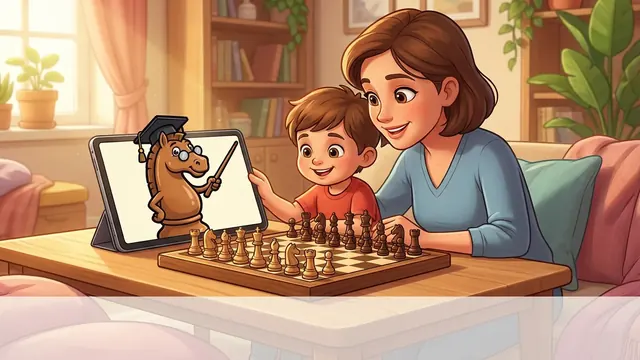
- Rules and first lessons. The Chess Academy Kids course is guided by a knight professor with a voice: how each piece moves, check and checkmate, tactics, how to find the best move and how to start well. We describe it in chess course with the knight professor.
- Practice at any hour. No travelling, no timetables, on the sofa or the train.
- A patient opponent. The game mode has three levels and a coach that rates each move and explains why. It is in playing against the app with a coach.
- Puzzles. Short, with hints, to train tactics. Chess puzzles for kids.
- Follow-up for you. The progress report for parents tells you what they have practised, without you needing to know chess.
- A fixed cost. Pro is a one-time purchase, no subscription, with Family Sharing and several child profiles. See chess without subscription: one-time purchase. And the first course module and level 1 are free to try first.
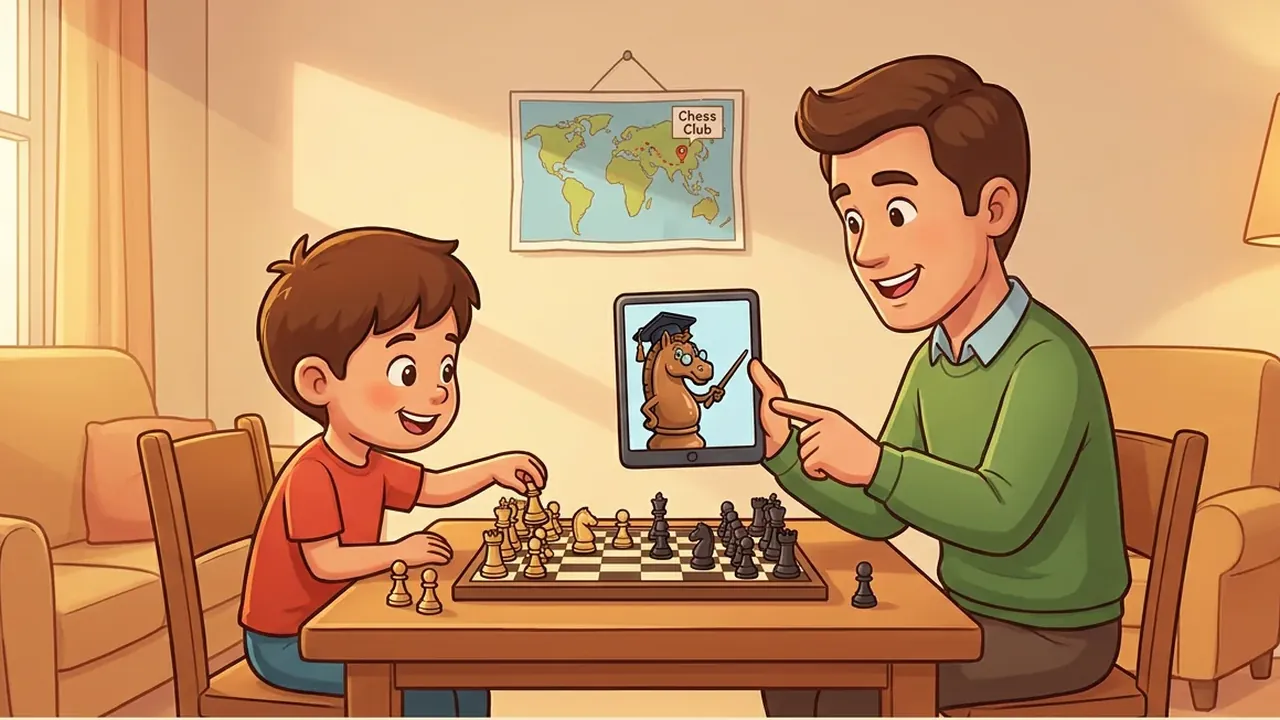
What an app does not do: it does not see your child, shake their hand or take them to a tournament. It is a good teacher to start with, not a replacement for a coach to go far.
What does your child need right now?
One way to decide without going in circles is to ask what stage they are at:
| Stage | What they usually need |
|---|---|
| Curiosity (ages 4 to 6, first weeks) | A short game at home, with you, using a board and an app. Not a club. |
| Learning the rules and basic tactics | A home routine with course and puzzles; a friend or relative to play with. |
| Already plays well and wants more opponents | A club, even once a week, or games with other people. |
| Wants to compete | A club or a coach with tournament experience. |
This is not a rigid rule but a guide. Every child is different, and many prefer a club from the start for the atmosphere. If that is your case, go for it.
When the club is far away or costly
No invented prices: every city has different fees, and the prudent thing is to ask. Before ruling out or accepting, some ideas:
- Ask for a trial class. Many clubs and teachers offer a free or reduced-cost first class. It is the best way to know whether the style fits.
- Ask at school. Many schools have a chess after-school activity, usually closer and at a convenient time.
- Check libraries and community centres. Sometimes there are chess workshops for children at small fees.
- Compare per hour and per child, not per month. A group with fewer children may balance out.
- Ask about the instructor's training (child pedagogy, not just playing level).
- Think about frequency. You may not need every week: a class every two weeks, plus practice at home, can be enough at the start.
If no option fits, the home routine is not a second-rate plan B: it is a valid way to learn. Many children start this way.
A weekly routine at home
A simple routine, 15 to 20 minutes a day, four or five days:
- Monday: one course lesson (5 to 10 minutes) and one puzzle.
- Tuesday: five short puzzles with hints.
- Wednesday: one game against the app at their level, with the coach.
- Thursday: one game with you (or a relative) on a physical board.
- Friday: review a move that went badly, looking at why.
- Weekend: free, or a family mini-tournament.
An example of what is practised early: recognising a simple checkmate. Here the rook goes up and leaves no escape.
If your child wants to know more, see back rank mate and how to teach chess at home. And if you do not know how to play, read I don't know chess and I want to teach my child.
When to step up to a club
Signs it is time:
- They beat everyone nearby (the app at its highest level included) and get bored.
- They ask to play other children or watch real games.
- They talk about tournaments or ask about the clock.
- They have chess questions you cannot answer.
Then a club is not an unnecessary expense, it is the next step. And the app can remain the daily training between classes.
In short
A teacher or club does things an app does not: look at your child, face them with people, compete and build community. But to start, a guided app and a 15-minute routine are enough in many homes, and it is a valid way to learn when the club is far away or does not fit the budget. The best is often a combination: home at first, club when the child asks. There is no single answer; there is the one that fits your child and your family.
Is an app enough to learn chess?
For the early stages, yes: rules, basic tactics and first games. An app does not see your child or face them against other people, so when they want to compete or play other children, a club or teacher offers something it cannot.
When should I sign my child up for a chess club?
When they already master the basics, beat everyone nearby and ask for more opponents, or when they want to compete. Also if they enjoy a group atmosphere from the start. Many families begin at home and step up later.
Can I combine an app with lessons?
Yes, and it is a good option: the app serves as daily practice (lessons, puzzles and games with a coach) and the classes bring a person's eye, other opponents and competition. Ask the teacher what to practise at home.
Sources
- FIDE, commission on chess in schools (5 October 2013), minutes, annex 59. https://www.fide.com/images/stories/NEWS_2013/FIDE/Congress/Annexes/Annex_59.pdf (accessed 2026-10-26; only what is quoted about the pedagogical training of those who teach children).